

9070 vs 9070 XT-Which RDNA 4 GPU Should You Actually Buy?
So you’re trying to pick between the 9070 vs 9070 XT and you can’t decide. Makes sense. Both cards are RDNA 4, both have 16GB GDDR6, and they’re only $50 apart. On the surface it looks like a no-brainer to just grab the XT, but it’s actually a bit more nuanced than that, especially depending on what CPU you’re running. We put both cards through our bottleneck calculator with the most common CPU pairings people are actually using right now. The results will help you figure out which one actually makes sense for your build.
Table of Contents
This guide is based on desk research, not hands-on lab testing. We compare published manufacturer specifications, weigh real-world compatibility and value for each use case, track current prices and availability on Amazon, and reference publicly available benchmark data from established review outlets. We do not run our own hardware tests — any performance figures are estimates drawn from public sources and will vary with your system, drivers, and settings.
Quick Specs: 9070 vs 9070 XT
| Spec | RX 9070 | RX 9070 XT |
|---|---|---|
| Architecture | RDNA 4 | RDNA 4 |
| Compute Units | 56 CU | 64 CU |
| Stream Processors | 3,584 | 4,096 |
| VRAM | 16GB GDDR6 | 16GB GDDR6 |
| Memory Bus | 256-bit | 256-bit |
| Boost Clock | ~2,500 MHz | ~2,970 MHz |
| TDP | 220W | 304W |
| Recommended PSU | 650W | 750W |
| Launch MSRP | $549 | $599 |
| PCIe | PCIe 5.0 | PCIe 5.0 |
What’s Actually Different Between the Two
The XT has more compute units (64 vs 56), more stream processors, and a higher boost clock. On paper that looks like a big gap but in real gaming it doesn’t translate 1:1. Both cards run above their rated boost clocks a lot of the time anyway, so the actual in-game difference is smaller than the spec sheet suggests.
The bigger thing to pay attention to is power draw. The base 9070 uses 220W. The XT jumps to 304W. That’s 84W more, which is a pretty big leap. If you’re on a 650W PSU right now, the XT might force you to upgrade your power supply too, which adds to the cost. The 9070 fits in a 650W system no problem.
Bottleneck Analysis: Which CPU Works Best With Each?
This is the part most GPU comparison articles skip. Your CPU matters a lot here. If your processor can’t keep up with the GPU, you’re leaving performance on the table no matter which card you pick. We ran both GPUs through our bottleneck calculator with the CPUs people are most commonly pairing them with.
Bottleneck % at 1080p — Common CPU Pairings
| CPU | RX 9070 | RX 9070 XT |
|---|---|---|
| Ryzen 7 5700X8C/16T • DDR4 | 5% | 15% |
| Ryzen 5 7600X6C/12T • DDR5 | 2% | 11% |
| Ryzen 7 7800X3D8C/16T • DDR5 | 4% | 14% |
| Core i5-13600K14C/20T • DDR5 | 18% | 7% |
| Core i7-14700K20C/28T • DDR5 | 12% | 1% |
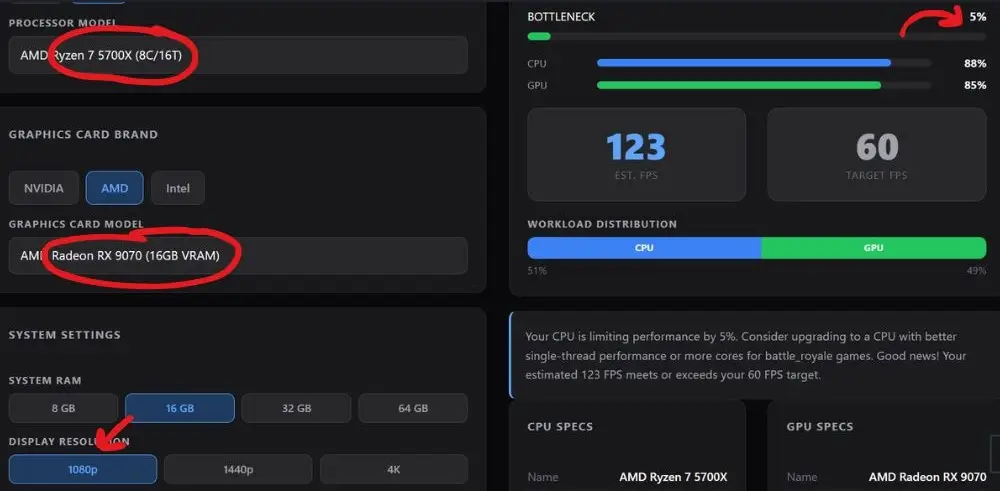
The Ryzen 7 5700X pairs cleanly with the RX 9070 at 1080p, showing just a 5% CPU bottleneck. Workload is nearly split down the middle at 51% CPU / 49% GPU, which means neither component is sitting idle. The estimated 123 FPS clears the 60 FPS target with plenty of headroom.
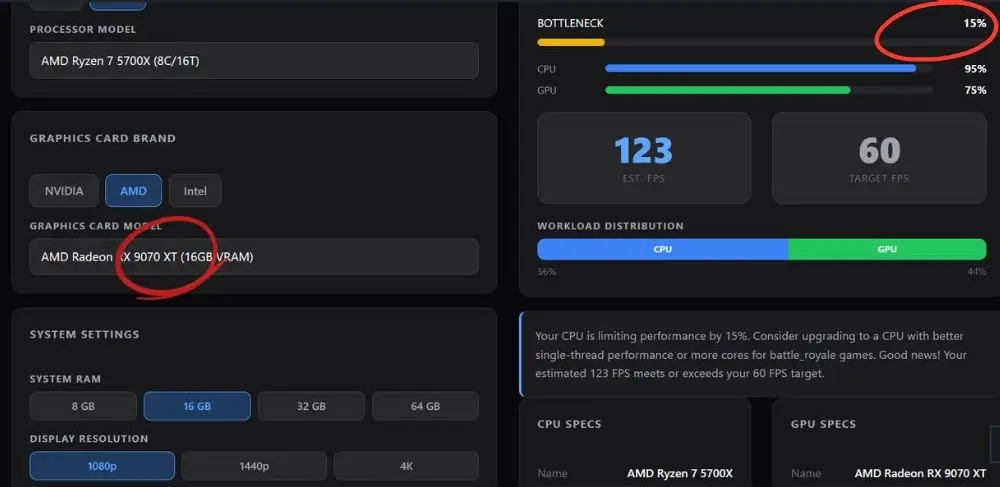
Pair the same Ryzen 7 5700X with the RX 9070 XT and the bottleneck jumps to 15%. The CPU is now running at 95% load while the GPU sits at 75%; meaning the 5700X is genuinely holding the XT back at 1080p. You’re still hitting 123 FPS, but the XT isn’t being fully utilized. At 1440p this gap closes considerably.
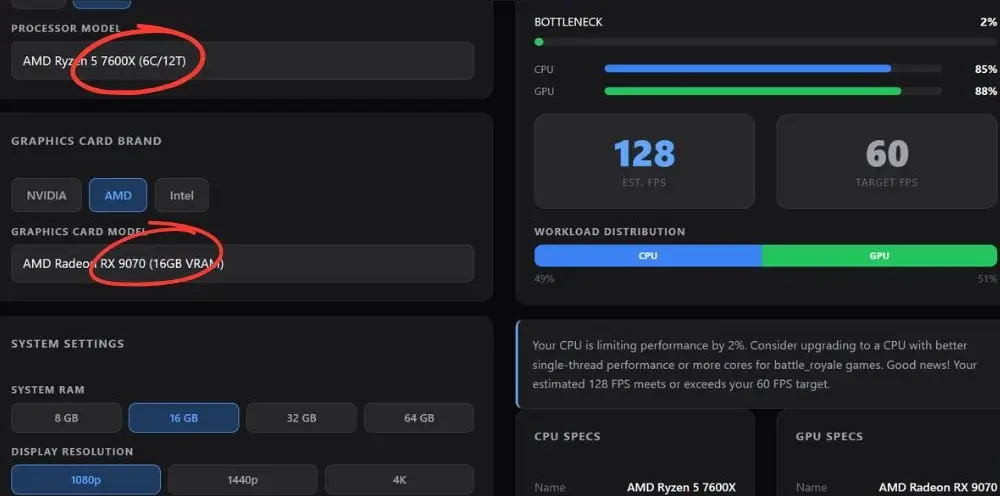
The Ryzen 5 7600X is one of the cleanest matches for the RX 9070 at 1080p; just 2% bottleneck with a near-perfect 49% CPU / 51% GPU workload split. Estimated FPS comes in at 128, and both components are pulling their weight without either one throttling the other.
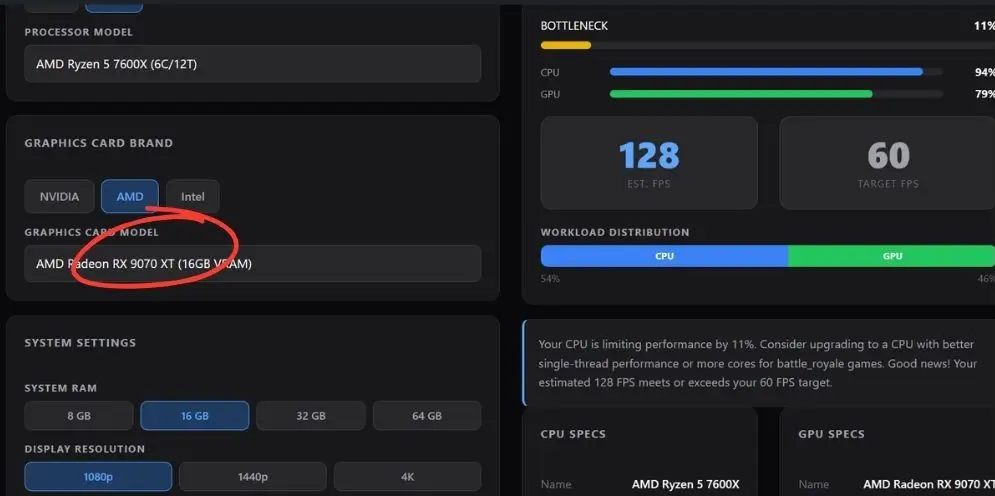
Step up to the RX 9070 XT with the same Ryzen 5 7600X and the bottleneck rises to 11%. CPU load hits 94% while the GPU is only at 79%, so the 7600X’s 6-core design starts showing its ceiling at 1080p with the more powerful card. FPS stays at 128, but you’d see a bigger gap open up at 1440p where the XT can breathe.
9070 vs 9070 XT at 1440p
Most people buying a card in this range are gaming at 1440p, and this is where the 9070 XT vs 9070 comparison gets real. At 1440p the GPU does most of the work, so CPU bottlenecks matter less and you actually start to see the difference between the two cards in your frame rate.
Third-party benchmarks from launch show the XT is about 13% faster at 1440p on average. GamersNexus clocked the gap 11-13% across their full game suite. That’s not nothing. It’s the difference between 100fps and 88fps in a demanding game, or staying above 60fps vs dipping below it at higher quality settings. Whether that matters to you depends on your target fps and the games you play.
That said, the base 9070 is still a really solid 1440p card. It handles ultra settings in most games without any issues. Both cards also support FSR 4, so you’ve got AMD’s AI upscaling on either one if you need extra frames.
Estimated FPS at 1440p Ultra — Popular Games
| Game | RX 9070 | RX 9070 XT | XT Advantage |
|---|---|---|---|
| Cyberpunk 2077 | ~106 fps | ~118 fps | +11% |
| God of War Ragnarok | ~130 fps | ~148 fps | +14% |
| Baldur’s Gate 3 | ~118 fps | ~132 fps | +12% |
| Call of Duty: Black Ops 6 | ~105 fps | ~118 fps | +12% |
| Hogwarts Legacy | ~120 fps | ~136 fps | +13% |
| The Last of Us Part I | ~93 fps | ~106 fps | +14% |
9070 vs 9070 XT at 4K
When you look at the 9070 vs 9070 XT 4K numbers, the XT pulls ahead by about 15% on average. At 4K the GPU is doing almost everything, so CPU bottlenecks are basically gone and all those extra compute units in the XT actually get to do their job.
But the base 9070 is not a bad 4K card at all. If you want 60fps at 4K ultra in most games today, the base model can get you there. The XT is the better pick if you want more headroom, higher fps targets, or future-proofing for more demanding games coming out over the next year or two.
The 9070 vs 9070 XT 4K gap also gets smaller the moment you turn on FSR 4. Quality mode FSR 4 at 4K on RDNA 4 looks really good, and if you’re fine using it then the base 9070 becomes an even easier choice at 4K. We have a full FSR 4 guide covering supported games, how to enable it, and how it compares to DLSS 4 if you want the full breakdown.
Quick Comparison: 9070 vs 9070 XT vs RTX 5070
How all three RDNA 4 / Ada competitors stack up at a glance.
| RX 9070 | RX 9070 XT ★ | RTX 5070 | |
|---|---|---|---|
| Architecture | RDNA 4 | RDNA 4 | Blackwell |
| VRAM | 16GB GDDR6 | 16GB GDDR6 | 12GB GDDR7 |
| TDP | 220W | 304W | 250W |
| 1440p Perf. | Strong | Best in class | ~20% slower |
| 4K Perf. | Good (60fps+) | Excellent | ~29% slower |
| Ray Tracing | Good | Good | Slightly better |
| AI Upscaling | FSR 4 | FSR 4 | DLSS 4 |
| PSU Needed | 650W | 750W | 750W |
| Launch MSRP | $549 | $599 | $549* |
| Value Pick? | Yes | Best value | No |
★ Best overall pick at this price tier. RTX 5070 performs roughly 20–29% slower at 1440p–4K vs the 9070 XT despite similar MSRP. *RTX 5070 street prices often exceed MSRP significantly.
The RTX 5070 being in that table might surprise you. At roughly the same launch price, it’s slower than both AMD cards at 1440p and 4K, and it only comes with 12GB of VRAM vs 16GB on both 9070s. The only real reason to pick the 5070 is if you’re deep in the Nvidia ecosystem and need DLSS 4 specifically, or if you care about ray tracing performance more than rasterization. For straight-up gaming performance per dollar, the AMD cards win here.
We broke down the full Nvidia vs AMD picture if you want to dig deeper into that comparison.
Who Should Get the Base RX 9070?
In the RX 9070 vs RX 9070 XT comparison, go with the base 9070 if your PSU is 650W or under and you don’t want to spend extra on a new one. The 9070’s 220W TDP works fine with a 650W unit. It also makes more sense if your CPU is older, like a Ryzen 5 5600X or a 12th gen Intel chip, because those processors will bottleneck the XT’s extra headroom anyway and you won’t get the full benefit.
If you’re gaming at 1080p, the base 9070 is also more than enough. At 1080p your CPU is doing more of the work, so the extra GPU power in the XT often goes to waste. Save the $50 unless you’re planning to upgrade your monitor soon.
Who Should Get the RX 9070 XT?
Most people. The $50 difference for 13-15% more performance at 1440p and 4K is a good deal. If your CPU is a Ryzen 5 7600X or better, or anything in the X3D lineup, the XT will actually use all that extra power and you’ll feel the difference in games. If you’re on a 7800X3D specifically, check our best GPU for Ryzen 7 7800X3D guide; the 9070 XT is one of the top picks there.
Just make sure your PSU is up to it. A 750W unit is the safe choice with the XT. If you’re pairing it with a power-hungry CPU on top, lean toward 850W to give yourself some breathing room.
Frequently Asked Questions
Is the AMD Radeon RX 9070 XT worth the extra money over the 9070?
For 1440p and 4K, yes. You’re paying about 9% more and getting 13-15% more performance. That’s a good trade. For 1080p or if your CPU is older, the base 9070 is probably all you need.
What CPU should I pair with the AMD Radeon RX 9070 or 9070 XT?
The base 9070 works great with a Ryzen 5 7600X or Core i5-13600K. For the 9070 XT, go with a Ryzen 7 7700X or better, or anything in the X3D lineup, so you’re not leaving performance on the table. Check the bottleneck data above for your specific CPU.
Can I undervolt the 9070 XT to reduce power draw without losing performance?
Yes, and a lot of people do this. A modest undervolt on the XT can bring power draw down noticeably while keeping almost all the performance. u003cbru003eUsers have reported getting the XT down to around 270W with basically no fps loss. It takes a bit of trial and error but it’s worth doing if you get the XT and want it to run cooler and quieter.u003cbru003eOur u003ca href=u0022https://mypcbottleneck.com/how-to-overclock-gpu/u0022u003eGPU overclocking guideu003c/au003e covers undervolting too with step-by-step instructions for RDNA 4 cards.
How much power do these cards need?
The AMD Radeon RX 9070 needs at least a 650W PSU. The 9070 XT pulls 304W so you want a 750W PSU for that one. If your CPU is a high-end chip too, go 850W to give yourself some headroom.
The 9070 XT uses way more power than the base 9070. Is the performance jump actually worth it?
This is one of the most common questions people ask when picking between these two. The XT draws about 84W more; that’s a 38% jump in power. But in real gaming the performance gap is only around 10-13%. u003cbru003eSo yeah, the base 9070 is the more efficient card by a mile. If you game in a hot room, care about electricity costs, or just want a quieter, cooler system, the base 9070 is the smarter pick. The XT makes sense if you want max performance and your case airflow is decent.
Is 850W enough for the 9070 XT, or do I need to upgrade my PSU?
850W is fine for most builds with the 9070 XT. AMD officially recommends 750W, so 850W gives you comfortable headroom even with a mid-to-high-end CPU. One thing to watch: monitoring software like HWInfo can show power spikes of 400W+ on the 9070 XT. u003cbru003eThese are very short transient spikes, not sustained draw, so your PSU doesn’t need to handle them continuously. A quality 850W unit handles this without any issues.
Are the high VRAM temperatures on the 9070 XT normal?
This comes up a lot in owner forums. Many 9070 XT cards run VRAM temps in the 85-95C range under load, which sounds alarming but is actually common across most AIB models. u003ca href=u0022https://forums.tomshardware.com/threads/9070-xt-vs-9070.3882653/u0022 target=u0022_blanku0022 rel=u0022noreferrer noopeneru0022u003eTom’s Hardware u003c/au003ecommunity discussion confirms this is widespread across different brands. The GDDR6 chips used have a thermal limit around 105-108C, so hitting 90C during a gaming session isn’t a danger zone. .u003cbru003eThat said, if your card is regularly hitting above 95C on VRAM, tweaking your fan curve to be more aggressive helps bring it down. Check our u003ca href=u0022https://mypcbottleneck.com/gpu-temperature-range/u0022u003eGPU temperature range guideu003c/au003e to understand what’s safe for your card.
Is the RX 9070 XT better than the RTX 5070?
For 9070 XT vs 9070 straight-up gaming performance, yes. The 9070 XT is faster at both 1440p and 4K, and it has 4GB more VRAM. The RTX 5070’s advantages are DLSS 4 and slightly better ray tracing. u003cbru003eIf you play a lot of ray tracing-heavy games or are locked into the Nvidia ecosystem, the 5070 has a case. For most gamers just wanting the best fps for their money, the 9070 XT wins.
Do both cards support FSR 4?
Yes. Both the 9070 and 9070 XT are RDNA 4 cards and support FSR 4 fully. This includes the improved AI-based quality mode that looks noticeably better than older FSR versions at 1440p and 4K. You’re not giving anything up on the upscaling side by going with the base 9070.
Final Words
We may earn a commission from purchases made through these links, at no extra cost to you.
BEST VALUE
RX 9070 XT — The smarter pick for most buyers at 1440p and 4K. A 9% price premium for 13–15% more performance is a genuinely good deal. Needs a 750W PSU.
BUDGET PICK
RX 9070 — Best if you’re PSU-limited, CPU-limited, or strictly gaming at 1080p. Still a strong GPU in its own right.
SKIP
RTX 5070 — Slower than both AMD cards at 1440p and 4K, with 4GB less VRAM. Hard to justify at similar prices.
