

RX 9070 XT vs RTX 5070 Ti – Which GPU Is Best to Buy
Searching for RX 9070 XT vs RTX 5070 Ti and now quickly making your decision based on the AI overview snippet. Hold on, that data might be pulled from a single game. That’s not the full picture. The honest answer is the RX 9070 XT and RTX 5070 Ti trade blows in most games at 1440p and 4K, the performance gap between them is just 3 to 5 percent on average. But in May 2026, the RTX 5070 Ti is selling for around $990 to $1,200 at retail, while the RX 9070 XT can be found for $670 to $850. That price gap of $200 to $350 makes the RX 9070 XT the stronger gaming value for most people. The RTX 5070 Ti is still the better card for ray tracing, DLSS 4, and creative workloads.
| For pure gaming value, most users should choose the RX 9070 XT.For premium features and productivity work, choose the RTX 5070 Ti. |
These two graphics cards have been the most talked-about GPUs on Reddit, YouTube, and gaming forums. Both GPUs perform very close in many games, but there is a big difference in price, which is why many gamers compare them.
In this guide, we will look at gaming benchmarks, specs, ray tracing, power use, features, and the best CPUs for each card. We have also answered some common questions people are asking in forums right now.
This guide is based on desk research, not hands-on lab testing. We compare published manufacturer specifications, weigh real-world compatibility and value for each use case, track current prices and availability on Amazon, and reference publicly available benchmark data from established review outlets. We do not run our own hardware tests — any performance figures are estimates drawn from public sources and will vary with your system, drivers, and settings.
Quick Overview: RX 9070 XT vs RTX 5070 Ti
Before we look at the detailed specs of the 9070xt vs 5070 ti, here’s a quick overview of their main features and differences.
| Feature | RX 9070 XT | RTX 5070 Ti | Winner |
| Launch Price (MSRP) | $599 | $749 | RX 9070 XT |
| 2026 Street Price | ~$670 to $850 | ~$990 to $1,200+ | RX 9070 XT |
| VRAM | 16 GB GDDR6 | 16 GB GDDR7 | RTX 5070 Ti (faster mem) |
| 1440p Avg Performance | Very Strong | ~5% Faster | Tie (too close) |
| 4K Raster Avg | Very Strong | ~5% to 8% Faster | RTX 5070 Ti |
| Ray Tracing | Much Improved (RDNA 4) | Better Overall | RTX 5070 Ti |
| Upscaling | FSR 4 | DLSS 4 with Multi Frame Gen | RTX 5070 Ti |
| Power Efficiency | Good | Better | RTX 5070 Ti |
| Value Per Dollar | Outstanding | Premium pricing | RX 9070 XT |
| AI and Creator Work | Decent | Significantly better | RTX 5070 Ti |
Now let’s have a look at their full specs comparison.
RTX 5070 Ti vs RX 9070 XT: Full Specs Side by Side
Both cards use similar manufacturing processes. The RX 9070 XT is built on TSMC’s N4P node, and the RTX 5070 Ti uses TSMC’s 4N node. Both are effectively 5nm class chips, meaning neither has a big manufacturing advantage over the other.
| Spec | RX 9070 XT | RTX 5070 Ti |
| Architecture | RDNA 4 (Navi 48) | Blackwell (GB203) |
| Manufacturing Node | TSMC N4P (~5nm) | TSMC 4N (~5nm) |
| Shader / CUDA Cores | 4,096 Stream Processors | 8,960 CUDA Cores |
| Compute Units / SMs | 64 CUs | 70 SMs |
| Boost Clock | 2,970 MHz | 2,452 MHz |
| Raw FP32 Performance | ~49 TFLOPS | ~44 TFLOPS |
| RT Cores | 64 (3rd Gen) | 70 (4th Gen) |
| AI / Tensor Cores | 128 (2nd Gen) | 280 (5th Gen) |
| Transistors | 53.9 billion | 45.6 billion |
| Die Size | 357mm² | 378mm² |
| VRAM | 16 GB GDDR6 | 16 GB GDDR7 |
| Memory Speed | 20 Gbps | 28 Gbps |
| Memory Bandwidth | 640 GB/s | 896 GB/s |
| Memory Interface | 256-bit | 256-bit |
| ROPs | 128 | 96 |
| TDP | 304W | ~285 to 300W |
| Required PSU | 750W | 750W |
| Power Connector | 2x or 3x 8-pin | 12V-2×6 |
| Release Date | March 6, 2025 | February 20, 2025 |
The biggest technical gap between these two cards is memory technology. The RTX 5070 Ti uses GDDR7 memory at 28 Gbps, giving it 896 GB/s of memory bandwidth. The RX 9070 XT uses GDDR6 at 20 Gbps, which gives 640 GB/s. That is a 40 percent bandwidth advantage for NVIDIA, which shows up in some memory-heavy workloads, especially at 4K with very high texture settings.
RX 9070 XT vs RTX 5070 Ti Benchmark
1-Gaming Benchmarks at 1440p
At 1440p, both GPUs perform very close to each other. According to TechSpot, the RTX 5070 Ti is only about 5 percent faster on average across a large game test. Meanwhile, The Verge found almost no noticeable difference in many real-world gaming tests. In most games, the performance gap stays very small, so both cards feel nearly the same during gameplay.
Games Where RX 9070 XT Wins at 1440p
| Game | RX 9070 XT Lead |
| Rocket League | ~41% faster |
| Call of Duty: Black Ops 6 | ~22% faster |
| Call of Duty: Modern Warfare II | ~15% faster |
| Horizon Forbidden West | ~10% faster |
| Microsoft Flight Simulator 2024 | ~10% faster |
| Ghost of Tsushima | ~12% faster |
| Warhammer III | ~11% faster |
| Resident Evil 4 (no RT) | Very close, AMD slightly ahead |
Games Where RTX 5070 Ti Wins at 1440p
| Game | RTX 5070 Ti Lead |
| GTA V Enhanced | ~29% faster |
| Assetto Corsa Competizione | ~35% faster |
| Forza Motorsport | ~14% faster |
| Final Fantasy XIV: Dawntrail | ~10% faster |
| The Riftbreaker | ~20% faster |
| Alan Wake 2 (with RT) | Significantly faster |
At 1440p, the RX 9070 XT is usually a better value and can match or beat the RTX 5070 Ti in many AMD-friendly games. The RTX 5070 Ti is better in NVIDIA optimised games, simulation titles, and games with heavy ray tracing.
2- RX 9070 XT vs RTX 5070 Ti 4K
At 4K, the RTX 5070 Ti gains a slightly larger lead, helped by its 40 percent higher memory bandwidth. The Vulkan benchmark found the 5070 Ti averaging 71.1 FPS vs 69.4 FPS for the 9070 XT, a 2.4 percent advantage. Across TechSpot’s wider 55-game suite, the average gap at 4K was again around 5 percent.
Games Where RX 9070 XT Wins at 4K
| Game | RX 9070 XT Lead |
| Rocket League | ~36% faster |
| Call of Duty: Black Ops 6 | ~19% faster |
| Horizon Forbidden West | ~11% faster |
| Warhammer III | ~12% faster |
| Cyberpunk 2077 (no RT) | Very slight AMD lead |
Games Where RTX 5070 Ti Wins at 4K
| Game | RTX 5070 Ti Lead |
| GTA V Enhanced | ~24% faster |
| Assetto Corsa Competizione | ~37% faster |
| Alan Wake 2 (with RT) | ~30 to 40% faster |
| Final Fantasy XIV | Clearly faster |
| Spider-Man 2 (with RT) | ~30 to 40% faster |
At 4K without ray tracing, both cards, 9070XT vs 5070 Ti, run most games smoothly. The RX 9070 XT gives strong 4K performance for a lower price, while both GPUs have 16 GB of VRAM, which is still enough for modern 4K gaming in 2026.
3- RX 9070 XT vs RTX 5070 Ti Ray Tracing Performance
This is where the RTX 5070 Ti clearly wins, especially for players who use ray tracing.
Standard Ray Tracing
NVIDIA’s 4th-generation RT cores in the 5070 Ti are more powerful than AMD’s 3rd-generation RT cores in the 9070 XT. That said, RDNA 4 is a major improvement over RDNA 3 for ray tracing. AMD has genuinely closed the gap in medium-weight RT games.
Real examples at 1440p:
F1 24 with ray tracing: The 9070 XT matched the 5070 Ti almost exactly—a notable win for AMD. Black Myth: Wukong with RT: The 5070 Ti is noticeably ahead, with AMD struggling in this highly RT-dependent title. Black Myth: Wukong (no RT): Very close results. Indiana Jones (ray tracing): RTX 5070 Ti is about 15 percent faster at 1440p.
4- Path Tracing (Cyberpunk 2077 and Other Titles)
This is where the difference becomes very big. In path tracing, the RTX 5070 Ti is much faster than the RX 9070 XT in games like Cyberpunk 2077 at 4K. It is also 30 to 40 percent faster in games like Alan Wake 2 and Spider-Man 2 with full ray tracing. If you care about heavy ray tracing at 4K, the RTX 5070 Ti is the better choice, while the RX 9070 XT is still fine for lighter ray tracing.
5- FSR 4 vs DLSS 4: Upscaling
In the DLSS vs FSR comparison, both cards come with significantly improved upscaling technologies compared to the previous generation.
DLSS 4 on the RTX 5070 Ti
DLSS 4 is NVIDIA’s latest AI upscaling system. It uses 5th-generation Tensor cores and adds Multi Frame Generation (MFG), which can create multiple AI-generated frames between each rendered frame. This dramatically multiplies your displayed frame rate in supported games. DLSS 4 is exclusive to Blackwell (RTX 50-series) cards. DLSS has wider game support than FSR as of mid-2026.
FSR 4 on the RX 9070 XT
FSR 4 is AMD’s best upscaling yet. It now uses AMD’s AI accelerator hardware and produces noticeably sharper results than FSR 3. Independent testing found that FSR 4 image quality sits between DLSS 3 and DLSS 4 in most comparisons, clearly better than the old FSR, but not quite at DLSS 4’s peak image quality. FSR’s frame generation is still not AI-based, which means it is less smooth than NVIDIA’s Multi Frame Generation, particularly at lower base frame rates.
As FSR 4 game support grows through 2026, AMD’s open-source approach means it can run on a wider range of hardware. For most gaming at 1440p without extreme path tracing, FSR 4 is very capable, and the quality difference versus DLSS 4 is not always obvious in motion.
6- Power Consumption
In the RX 9070 XT vs RTX 5070 Ti comparison, both cards sit in a similar power range, but the RTX 5070 Ti is more efficient:
The RX 9070 XT draws around 304 W under full gaming load. Real-world benchmarks have measured it sustaining close to 300 to 310W in demanding rasterization tests.
The RTX 5070 Ti draws around 285 to 300W and tends to consume less power while delivering the same or higher frame rates. This makes it more efficient on a frames-per-watt basis, particularly in lighter workloads or when using upscaling.
For actual builds, both cards require a minimum 750W power supply. A quality 850W PSU gives you comfortable headroom for either card or a high-end CPU.
7- Content Creation and AI Workloads
If you use your PC for video editing, 3D rendering, AI image generation, or machine learning alongside gaming, this matters a lot.
The RTX 5070 Ti has a significant advantage here. NVIDIA’s CUDA cores, Tensor cores, and mature CUDA ecosystem mean the 5070 Ti is 30 to 50 percent faster than the RX 9070 XT in tasks like Stable Diffusion, Blender GPU rendering, and Adobe Premiere Pro with AI acceleration. Professional software like DaVinci Resolve also performs better on NVIDIA hardware in many workflows.
The RX 9070 XT can handle content creation tasks, and it works well in open-source creative tools like Blender using AMD’s HIP compute platform. But if creative workloads are a regular part of your day, NVIDIA’s ecosystem is considerably more mature and supported.
Which CPU Should You Pair with Each Card?
Buying a great GPU is only half the job. Pairing it with the wrong CPU will create a bottleneck that prevents the card from reaching its full potential. This is one of the most common and expensive mistakes PC builders make.
If you just want to check whether your current CPU will bottleneck either of these cards at your target resolution, then you can use our free PC Bottleneck Calculator. Our advanced calculator accounts for DLSS 4, FSR 4, ray tracing, target FPS, and game type to give you an accurate result that you can trust.
If you want to upgrade your CPU but don’t know which one to choose, use the Optimal Match feature in our calculator. Just select your graphics card, click “Find Optimal CPU,” and it will show you the best CPU options starting from the best match.
For example, this is how you can find the best CPUs for AMD Radeon RX 9070 XT by using our calculator.
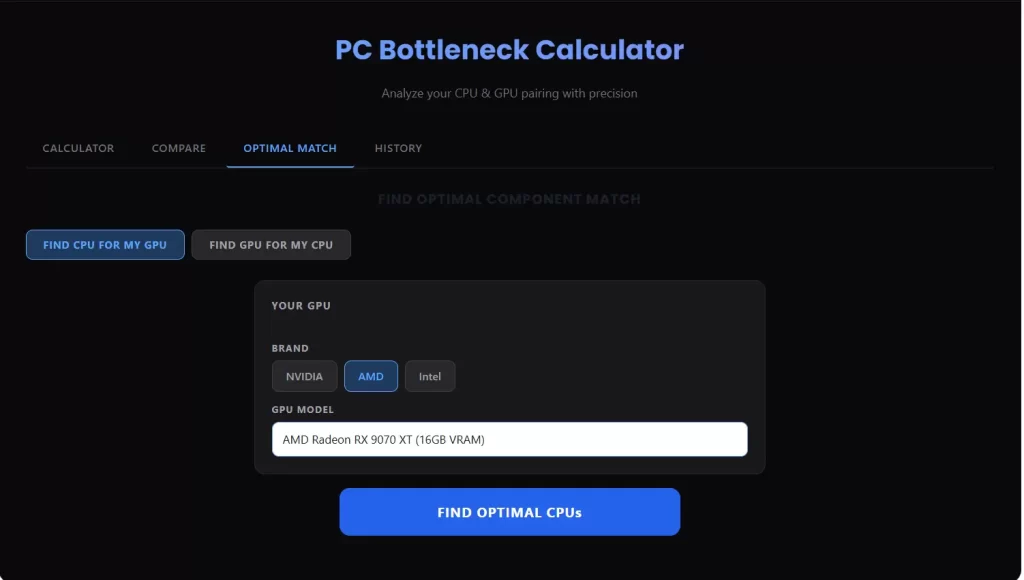
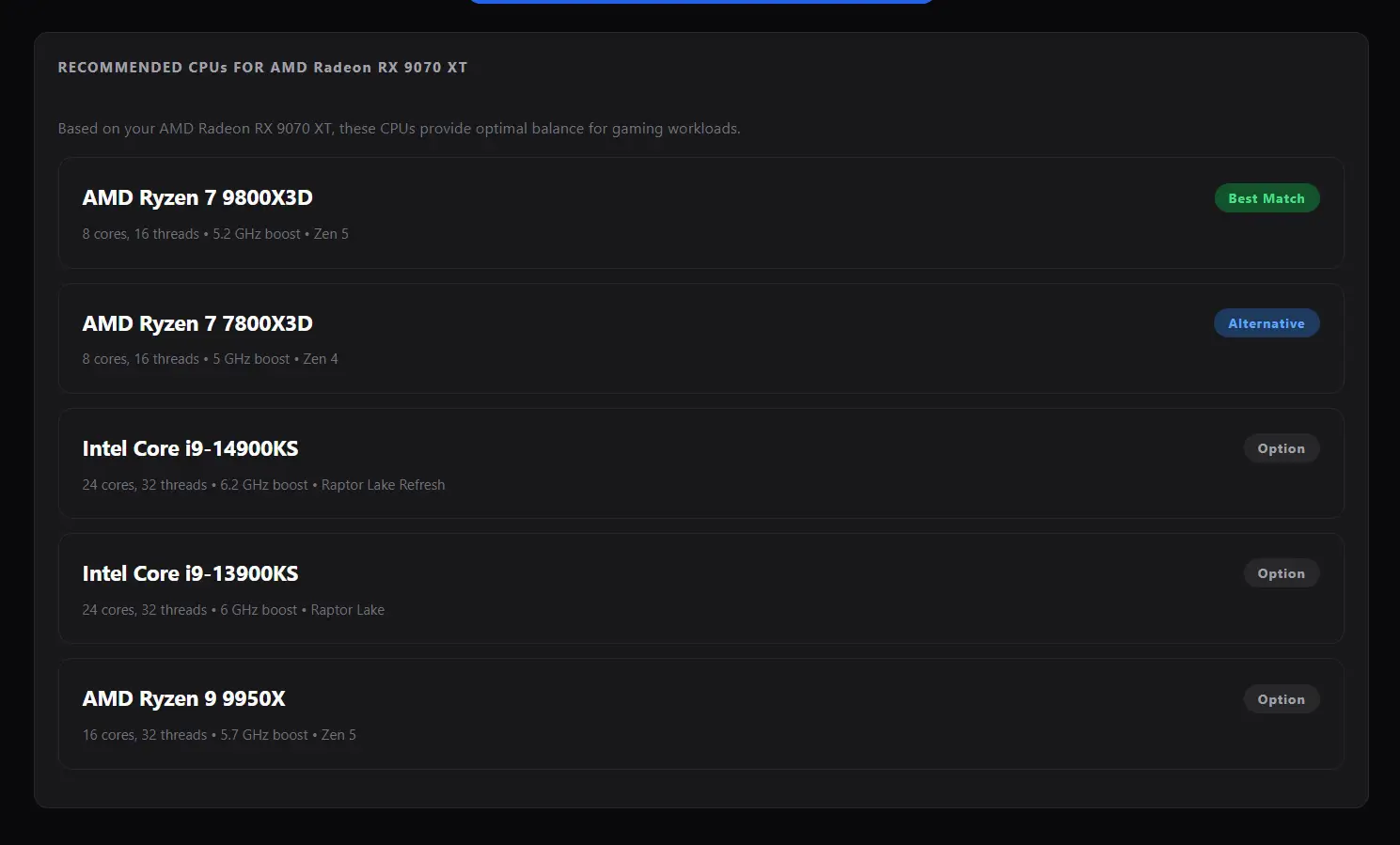
In the same way, you can find the Best CPU for RTX 5070 Ti
Learn more about what a CPU bottleneck actually looks like and how to spot one in your own system: What Is Bottlenecking My PC?
RAM Recommendation for Both Cards
Both the RX 9070 XT and RTX 5070 Ti should be paired with at least 32 GB of DDR5 in a dual-channel configuration. For AMD AM5 platforms, 6000 MHz DDR5 is widely considered the sweet spot for gaming performance. For Intel platforms, 5600 to 6400 MHz DDR5 works well.
Slow or single-channel RAM is one of the most common hidden bottlenecks. It limits the CPU’s ability to feed data to the GPU fast enough, especially in games that are sensitive to memory latency. Our DDR4 RAM Speeds for Gaming guide covers which RAM speeds make a real, measurable difference in FPS.
If you are getting low FPS despite owning a powerful GPU, your RAM configuration may be the reason. Read our guide: I Spent $800 on a New GPU and Still Got Low FPS — Here’s What Was Actually Wrong
Who Should Buy the RX 9070 XT?
We may earn a commission from purchases made through these links, at no extra cost to you.
The RX 9070 XT is a good choice if you want strong gaming performance at a lower price. Here are the main reasons:
- Great value for money at 1440p gaming
- Very close performance to the RTX 5070 Ti in most games
- Works well in shooters, open worlds, and strategy games
- Handles mid-ray tracing without major issues
- Good support for creative apps like Blender and DaVinci Resolve
- Often easier to find at a good price compared to NVIDIA cards
Who Should Buy the RTX 5070 Ti?
The RTX 5070 Ti is a good choice if you need more advanced features and stronger ray tracing performance. Here are the main reasons:
- Best for heavy ray tracing and path tracing games like Cyberpunk 2077, Alan Wake 2, and Spider-Man 2
- Much faster in ray tracing workloads compared to the RX 9070 XT
- Supports DLSS 4 with Multi-Frame Generation for higher smoothness in supported games
- Strong option for content creation tools like Blender, Premiere Pro, and Stable Diffusion
- Performs better in many NVIDIA optimised and Unreal Engine 5 games
- Becomes a better deal if the price difference is small or close to MSRP
FAQs
u003cstrongu003eIs the AMD Radeon RX 9070 XT good for 1440p gaming?u003c/strongu003e
Yes, the RX 9070 XT is an excellent choice for 1440p gaming in 2026. It can run most modern games at high or ultra settings with smooth and high frame rates. In many cases, its performance is very close to the RTX 5070 Ti while costing much less. This makes it one of the best value GPUs for 1440p high refresh rate gaming.
u003cstrongu003eIs the 9070 XT worth it over the 9070?u003c/strongu003e
Yes, if the price difference is not too big, the RX 9070 XT is the better choice. It offers stronger overall gaming performance and is a great option for smooth, high refresh rate gaming over the long term.
u003cstrongu003eIs the RTX 5070 Ti future-proof?u003c/strongu003e
The RTX 5070 Ti is a strong long-term GPU for 2026. It comes with 16 GB of fast GDDR7 VRAM, DLSS 4 with multi-frame generation, and strong ray tracing support, which helps it stay powerful in new games.u003cbru003eIt should handle 1440p gaming smoothly for around 4 to 5 years and 4K gaming for about 2 to 3 years with some settings adjustments in future titles. While no GPU is fully future-proof, the RTX 5070 Ti is a safe long-term choice if priced well.
u003cstrongu003eCan the RTX 5070 Ti run all games?u003c/strongu003e
Yes. The RTX 5070 Ti can run every current game, including the most demanding AAA titles. It delivers excellent performance at 1440p and strong results at 4K. With DLSS 4 enabled, it handles even very heavy games with comfortable frame rates. u003cbru003eThe only scenario where it struggles is native 4K with full path tracing and no upscaling, but even the RTX 5090 slows down under those conditions. For all practical gaming purposes, the 5070 Ti runs everything well.
u003cstrongu003eDoes the AMD Radeon RX 9070 XT graphics card use more power than the 5070 Ti?u003c/strongu003e
Slightly, yes, in most gaming scenarios. The RX 9070 XT has a rated TDP of 304W, and real-world measurements show it drawing around 300 to 310W under full load. u003cbru003eThe RTX 5070 Ti draws around 285 to 300W and tends to be more power efficient overall, delivering equal or higher FPS per watt. For your electricity bill and heat output, the difference is small, but the 5070 Ti has the edge. Both cards need a quality 750W to 850W power supply.
Final Verdict
Both GPUs are excellent, but they target different users. The RX 9070 XT is the best choice for most gamers because it offers stronger value and great performance at 1440p and 4K. The RTX 5070 Ti is better if you care about ray tracing, DLSS 4, and creative workloads.


