

4060 vs 5060- The Better NVIDIA GPU Revealed
Search 4060 vs 5060 and you’ll find the same number copy and pasted everywhere: the RTX 5060 is 20 to 30 percent faster. What most of those articles don’t tell you is where that number actually comes from. It’s pulled from lab tests running both cards on a flagship CPU most people don’t actually own, the kind built specifically so the CPU never slows the GPU down.
So we did something different. We ran the 4060 vs 5060 matchup through our own bottleneck calculator using real CPUs people actually game with, different CPUs like Ryzen 5 5600, Intel i5-12400F, etc, the kind of chips that sit in most mid-range builds right now, not a lab bench. We found that the actual performance difference depends a lot on your CPU and the resolution you’re playing at. In one test, it was nearly 50% smaller than the numbers shown in lab benchmarks.
This NVIDIA RTX 4060 vs NVIDIA RTX 5060 breakdown covers real specs, gaming performance, VRAM, power draw, and the actual tested numbers for common CPU pairings, not just a recycled spec sheet.
If you’re also weighing an AMD card against these two, our Nvidia vs AMD buying guide breaks down the full 2026 lineup, including where the RX 9060 XT fits into this same price range.
Quick Answer
In the 4060 vs 5060 comparison, the RTX 5060 is the better choice if you’re buying a new graphics card today. If you already have an RTX 4060, upgrading to the RTX 5060 may not be worth it unless you want DLSS 4 and better ray tracing performance.
Table of Contents
RTX 4060 vs RTX 5060- Spec Comparison
| Spec | RTX 4060 | RTX 5060 |
|---|---|---|
| Architecture | Ada Lovelace | Blackwell |
| CUDA Cores | 3,072 | 3,840 |
| Memory | 8GB GDDR6 | 8GB GDDR7 |
| Memory Bus | 128-bit | 128-bit |
| Memory Bandwidth | 272 GB/s | 448 GB/s |
| L2 Cache | 24MB | 32MB |
| RT Cores | 3rd Gen | 4th Gen |
| Tensor Cores | 4th Gen | 5th Gen |
| DLSS Support | DLSS 3 (single Frame Gen) | DLSS 4 (Multi Frame Gen) |
| TDP | 115W | 145W |
The headline change is the memory. In the above RTX 4060 vs RTX 5060 specs comparison, both cards stick with an 8GB, 128-bit setup, but the RTX 5060 swaps GDDR6 for GDDR7, which pushes bandwidth up by about 65 percent. That alone helps the 5060 avoid some of the stutters the 4060 ran into in memory-heavy games.
RTX 4060 vs 5060- Real Gaming Performance
Across independent benchmark roundups of RTX 5060 vs 4060, the NVIDIA 5060 lands roughly 20 to 30 percent ahead of the RTX 4060 in 1080p rasterization, and the gap opens up further in games with heavy ray tracing thanks to the newer RT cores. That’s a solid generational jump, similar to what we saw going from the RTX 3060 to the RTX 4060.
Want to see it in action instead of just reading numbers? This benchmark run tests both cards across 16 games at 1080p, 1440p, and 4K, including DLSS 4 Frame Generation and Multi Frame Generation:
Where it gets interesting is upscaling. The RTX 5060 supports DLSS 4 with Multi Frame Generation, which can generate up to three AI frames for every one real frame. The RTX 4060 is stuck on regular Frame Generation, which only adds one frame at a time. On paper that makes the 5060’s frame rate numbers look even bigger, but keep in mind generated frames don’t reduce input lag the way real frames do, so it matters more for visual smoothness than competitive play.
Neither card is a 1440p powerhouse. Both are built and marketed as 1080p cards first, with 1440p being doable at medium-high settings rather than maxed out.
If you want a deeper look at how DLSS 4 stacks up against AMD’s FSR 4, our DLSS vs FSR comparison breaks down image quality and FPS gains side by side.
Does the RTX 4060 or RTX 5060 Bottleneck Your CPU?
This is the part most comparison articles completely skip, and it’s the part that actually decides your real-world frame rate. A GPU upgrade only matters if your CPU can keep up with it.
We ran both cards through our Bottleneck Calculator paired against real CPUs people actually game with, not lab-only hardware, to show you where the bottleneck actually shows up.
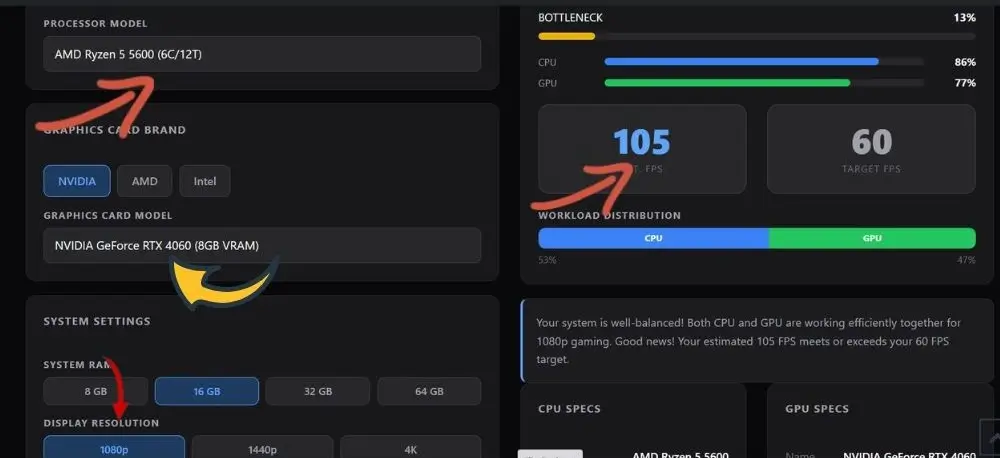
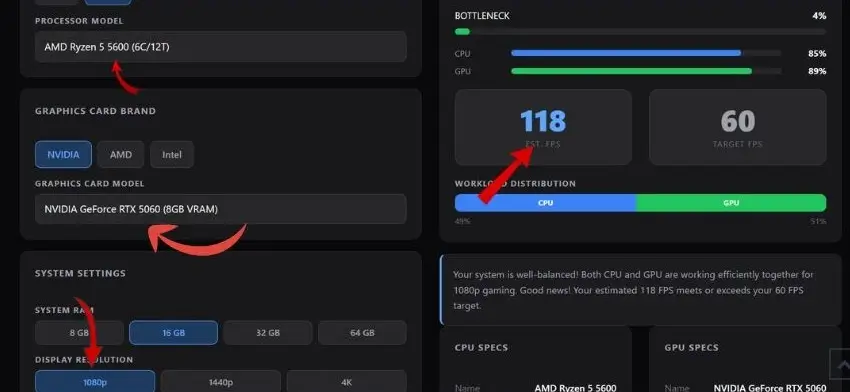
With this CPU at 1080p, going from the RTX 4060 to the RTX 5060 only takes you from 105 FPS to 118 FPS. That’s about a 12 percent gain.
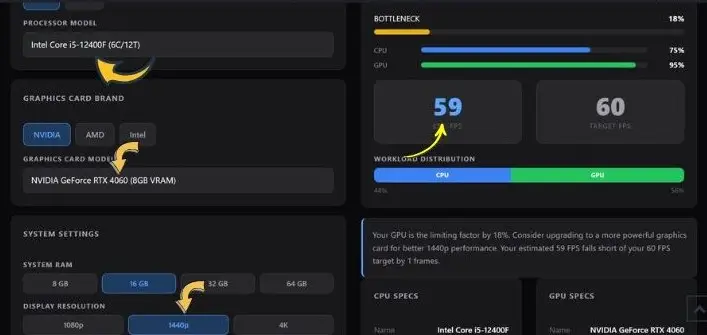
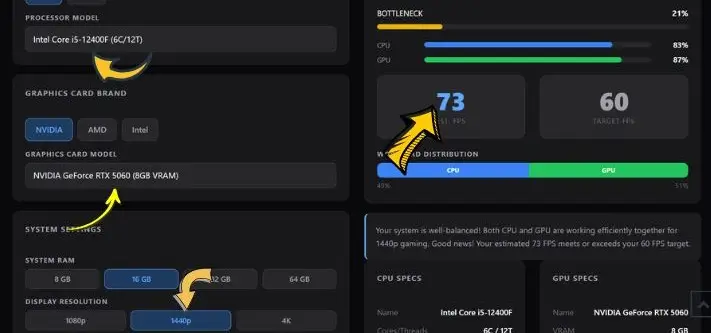
With this CPU at 1440p, the RTX 4060 actually misses 60 FPS, landing at 59. The RTX 5060 clears it easily at 73 FPS. That’s about a 24 percent gain, much closer to what big tech review sites report.
So, which result is correct?
The answer is that all of them are correct.
You may have seen some tests showing the RTX 5060 is only 12% faster than the RTX 4060, while others show a 24% improvement. Big review sites like Tom’s Hardware often report gains of around 20% to 30%. This can look confusing, but the difference comes from the hardware used for testing.
Sites like Tom’s Hardware test graphics cards with very powerful CPUs. They do this so the CPU does not limit the GPU’s performance. This allows the graphics card to run at its maximum speed and show its full potential. In these ideal test conditions, the RTX 5060 is usually around 20% to 30% faster than the RTX 4060.
However, most gamers do not use high-end CPUs. Many people have mid-range processors such as the Ryzen 5 5600 or Core i5-12400F. In these systems, the CPU can sometimes limit GPU performance, especially at 1080p resolution.
For example, in our 1080p test with the Ryzen 5 5600, the CPU was already working hard with the RTX 4060. After switching to the faster RTX 5060, the CPU could not keep up well enough to let the new card show its full performance. As a result, the real-world gain was only about 12%.
At 1440p, the situation changes. The GPU has to do more work to render the higher resolution, which reduces the CPU bottleneck. In our test with the Core i5-12400F, the RTX 5060 was about 24% faster than the RTX 4060, much closer to the results reported by Tom’s Hardware.
The key takeaway is that benchmark results of 4060 vs 5060 for different CPUs from review sites are not wrong. They show the maximum performance difference between the two GPUs. But your actual results depend on the CPU you use and the resolution you play at. If you have a mid-range CPU, the performance gain from upgrading may be smaller, especially at 1080p.
For build-specific recommendations, check our Best CPU for RTX 5060 guide for the full tested lineup, or our Best CPU for RTX 5070 and RTX 5070 Ti guide if you end up leaning toward a higher-tier card instead.
VRAM: Is 8GB Enough on Either Card?
Both the RTX 4060 and RTX 5060 ship with 8GB of VRAM, and this is genuinely the most argued-about point in the entire 4060 vs 5060 conversation. Builders on Reddit and hardware forums are split into two camps. One side says 8GB is still plenty for 1080p gaming since most people aren’t maxing out texture settings anyway. The other side points out that a handful of newer, more demanding titles already lean on more than 8GB at max settings, even at 1080p, and that buying an 8GB card today means you’re more likely to need an upgrade sooner.
The faster GDDR7 memory on the RTX 5060 helps it manage that 8GB more efficiently than the 4060’s older GDDR6, but it doesn’t add extra capacity. If you mainly play esports titles, older AAA games, or anything at 1080p on medium-high settings, 8GB on either card is fine. If you want a GPU that ages well at 1440p with high textures, you’ll want to look at the 16GB RTX 5060 Ti instead, or its closest AMD rival in our RX 9060 XT vs RTX 5060 Ti comparison.
Power Draw and Efficiency
The RTX 4060 sips power at a 115W TDP, which made it popular for budget builds and small form factor PCs that don’t have room for a beefy power supply. The RTX 5060 jumps to 145W, about 26 percent more power for that 20 to 30 percent performance gain, so efficiency per frame is roughly a wash or a slight win for the 5060 depending on the game.
If you’re working with an older or lower-wattage power supply, double check your headroom before going with the 5060. Once your build is up and running, our GPU temperature range guide covers safe idle and load temps for both NVIDIA and AMD cards so you know what’s normal.
4060 vs 5060: Who Should Buy Which
Get the RTX 5060 if:
- You’re building a new PC from scratch
- You want DLSS 4 and Multi Frame Generation
- You play newer titles with ray tracing turned on
- You want better memory bandwidth for the long run
Stick with the RTX 4060 if:
- You already own one and aren’t chasing ray tracing performance
- You’re on a tighter power budget or smaller PSU
- You mainly play esports titles or older games where the extra horsepower won’t matter much
Skip both if:
- You want to play modern AAA titles at 1440p with high textures long term. Look at the RTX 5060 Ti 16GB instead, or step up to our RTX 5070 vs RTX 5070 Ti comparison if your budget stretches further.
FAQs
Is the RTX 5060 worth it over the RTX 4060?
For most people, yes, but it’s not a huge jump. You get more speed, better ray tracing, and DLSS 4. If you already own a 4060 and don’t care about ray tracing, some people online say it’s smarter to skip this generation and wait for the next one.
Will the RTX 5060 be held back by my CPU?
Maybe. It depends on which CPU you have. An older or cheaper CPU can hold back the 5060 more than it held back the 4060, because the 5060 needs more help to show its full speed. Use the calculator above to check your exact CPU and see your real number.
Is 8GB of VRAM enough in 2026?
For 1080p gaming, yes, in most games right now. But this is a hot debate online. Some people say 8GB is fine. Others say new games are starting to need more, even at 1080p. If you want a card that lasts longer, get the 16GB RTX 5060 Ti instead.
Does the RTX 5060 have DLSS 4?
Yes. The RTX 5060 gets full DLSS 4, including Multi Frame Generation. The RTX 4060 only gets DLSS 3, with regular Frame Generation.
Can the RTX 4060 or RTX 5060 run games at 1440p?
Yes, both can run 1440p on medium to high settings, especially with DLSS turned on. Neither card is made for max settings at 1440p or 4K though.
Final Verdict- 4060 vs 5060
We may earn a commission from purchases made through these links, at no extra cost to you.
The RTX 5060 wins this matchup on paper and in real benchmarks, with meaningfully faster memory, more cores, and access to DLSS 4. But the real-world gap you’ll actually feel depends entirely on your CPU and the resolution you play at. Don’t take a generic spec sheet’s word for it. Run your exact CPU and GPU combo through our bottleneck calculator to see your real numbers before you buy.
