

Best 850W PSU 2026- Top Picks + Which GPUs It Fits
The best 850W PSU is not about brand names. Three things matter most: ATX 3.1 support, a native 12V-2×6 cable, and good results in independent lab tests. This guide shows which graphics cards an 850W power supply fits and which one it does not. Then it lists 850W models that reviewers rated well.
The short answer: 850W is the right size for the RTX 5080. It also gives extra room for the RTX 5070 Ti and RX 9070 XT. It is not enough for the RTX 5090.
Best 850W PSU-Quick Answer
🏆 Best 850W PSU Picks for 2026
| Pick | Best for | Why |
|---|---|---|
| Corsair RM850x | Best all-round | Did well on all five checks, no weak point found |
| Corsair RM850e | Quiet mainstream pick | Gold efficiency and low noise, but lower-tier parts |
| Montech Century II Gold | Efficiency on a lower budget | Very efficient, but average parts |
| Super Flower Leadex VII PRO | Steady voltage and spike response | Ripple is not the best in its class |
We did not lab test these units. Every pick comes from published lab reviews, and each one names its source.
Which GPUs does an 850W PSU fit?
NVIDIA and AMD publish the power supply size they recommend for each card, so start there. NVIDIA’s numbers assume a PC with a Ryzen 9 9950X, so a lighter CPU like the Ryzen 7 9800X3D gives you more room. For a closer look at CPU power, see our Ryzen 9 9950X3D vs Ryzen 7 9800X3D comparison.
Is 850W Enough for Your Graphics Card?
| GPU | Maker’s recommended PSU | Does 850W fit? |
|---|---|---|
| RX 9070 | 650W (AMD) | Yes, lots of room |
| RTX 5070 Ti | 750W (NVIDIA) | Yes, extra room |
| RX 9070 XT | 750W (AMD) | Yes, but check your exact card |
| RTX 5080 | 850W (NVIDIA) | Yes, right at the line |
| RTX 5090 | 1000W (NVIDIA) | No |
RTX 5070 Ti. NVIDIA lists 300W for this card and asks for a 750W power supply or greater. An 850W unit gives you room for a stronger CPU or a later upgrade. Read our guide on best-cpu-for-rtx-5070-and-rtx-5070-ti.
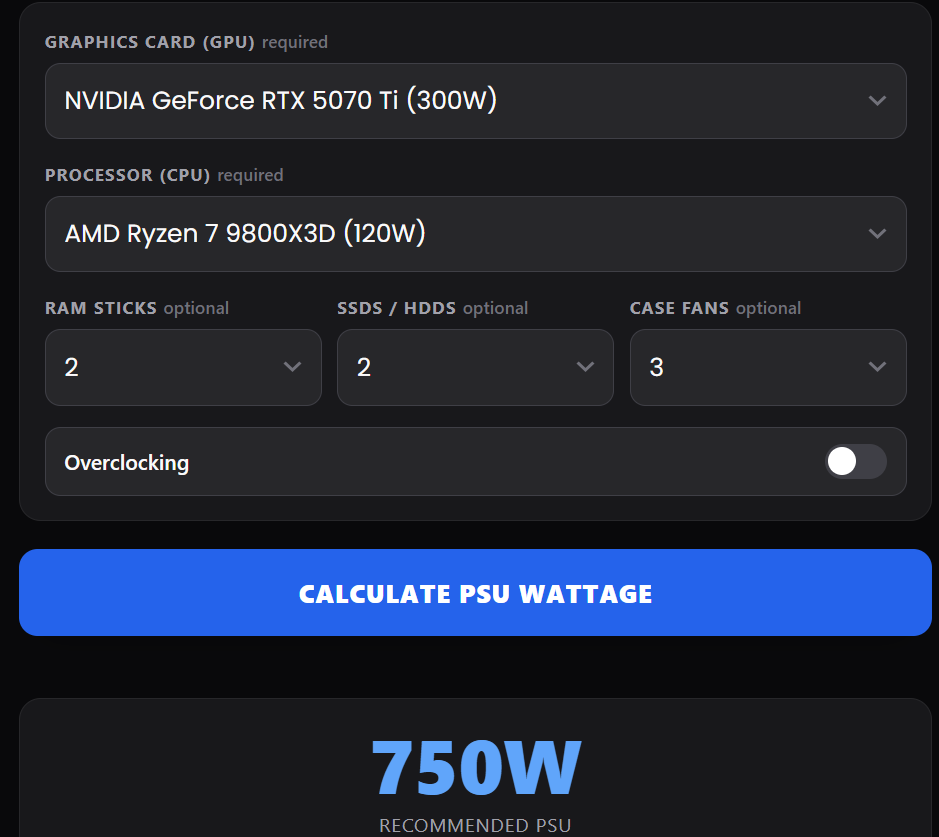
RTX 5070 Ti with a Ryzen 7 9800X3D. Our PSU calculator recommends 750W, the same number NVIDIA lists for this card. It is a sizing estimate, not measured power draw.
RX 9070 XT. AMD rates it at 304W total board power and recommends a 750W power supply. Some factory-overclocked cards ask for more. One review lists the ASUS TUF OC model with an 850W recommendation. Check the box of your exact card.
RTX 5080. NVIDIA lists 360W total graphics power and 850W required system power. That makes 850W the minimum, not a comfortable extra. A quality unit matters here. See our Ryzen 7 9800X3D and RTX 5080 pairing guide and best CPU for the RTX 5080.
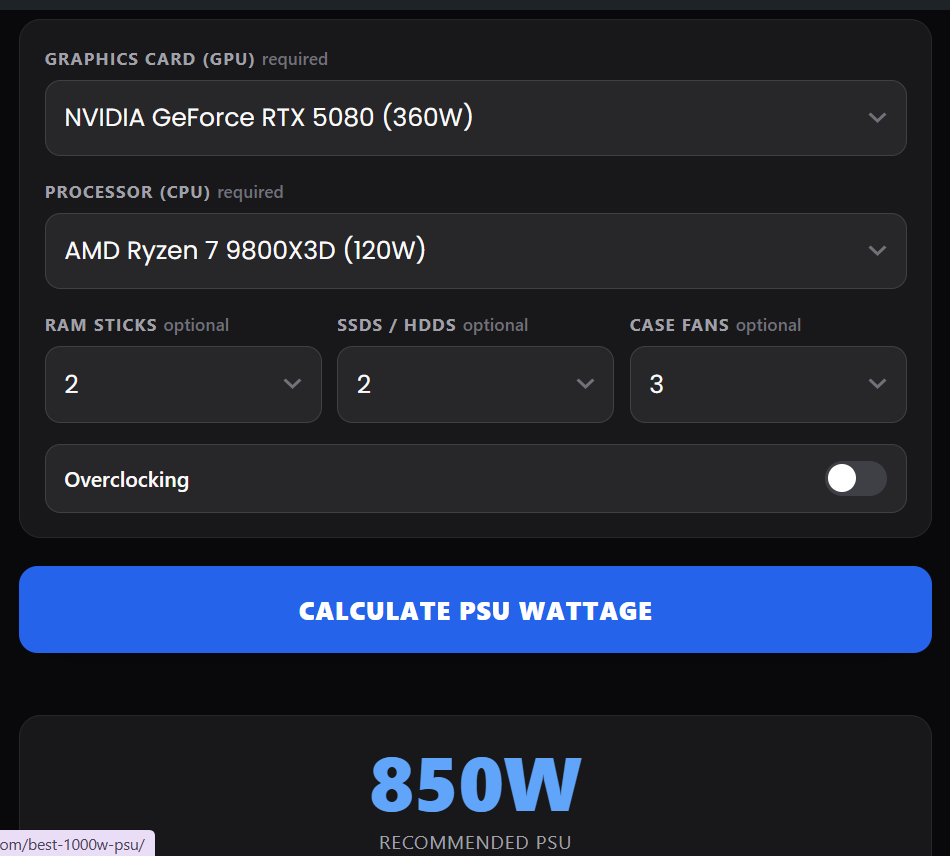
RTX 5080 with a Ryzen 7 9800X3D. Our PSU calculator recommends 850W, the same number NVIDIA lists for this card. It is a sizing estimate, not measured power draw.
RTX 5090. NVIDIA lists 575W for the RTX 5090 and a 1,000W minimum system power supply. Do not use 850W with this card. Read our best 1000W PSU guide.
Why watts are only half the story
Graphics cards can jump in power for a tiny moment. These spikes last from microseconds to milliseconds, so monitoring programs may not catch them. Seasonic also points out that extra wattage helps, but it does not guarantee the PSU can handle these load changes.
That is why the design of the PSU matters. ATX 3.0 introduced rules for how a PSU handles these short spikes, and ATX 3.1 kept them. ATX 3.1 also updated the 12V-2×6 connector design. MSI’s own PSU guide for the RTX 5070 Ti asks for an ATX 3.1 power supply to handle GPU power excursions.
Simple rule: buy ATX 3.1 with a native 12V-2×6 cable. Push the plug in all the way. A cheap 850W unit can be a worse choice than a good 750W one. For more on this, read Can a PSU bottleneck your PC? .
Best 850W PSUs
We did not test these ourselves. We read independent lab reports and reviews, then judged every unit on the same five checks:
- ATX 3.1 with a native 12V-2×6 cable. Needed for modern graphics cards.
- Voltage stability. Ripple is small ups and downs in the 12V line. Load regulation is how much the voltage moves when your PC’s power use changes. Lower is better for both.
- Efficiency. How much wall power becomes usable power. Cybenetics rates this as Gold, Platinum and so on.
- Noise. Whether the fan stays quiet while you game.
- Parts and warranty. Plus any weak point the reviewer found.
We called a unit “best all-round” only if it did well on all five and no reviewer flagged a weakness. Among the units below, only the Corsair RM850x did.
Corsair RM850x: best all-round
What reviewers found. KitGuru lists ATX 3.1 and PCIe 5.1 support, Cybenetics Gold efficiency, tight load regulation, great ripple suppression, and low noise until higher loads, and scored it 9.0. The Cybenetics lab report measured 24.20mV of 12V ripple at full load and 0.63% load regulation. HWBusters called it the performance leader in its 850W comparison. TweakTown lists a Corsair fluid-dynamic-bearing fan and a 10-year warranty.
What it means. KitGuru’s test table lists 120mV as the allowed 12V ripple, so 24.20mV is about one fifth of that limit. A load regulation of 0.63% means the 12V line moves by less than 0.1 volt when the load changes.
Our conclusion. It passes every check, and no reviewer we read flagged a weak point. That is why it ranks first. Pick it if you want one safe choice. Make sure you buy the standard RM850x, not the Shift version. Tom’s Hardware RM850x Shift review” to https://www.tomshardware.com/pc-components/power-supplies/corsair-rm850x-shift-850w-atx-31-power-supply-review
Corsair RM850e: quiet mainstream pick
What reviewers found. HWBusters lists Cybenetics Gold efficiency (88.568% at 115V, 90.783% at 230V), a Cybenetics A noise rating of 20 to 25 dBA, and ATX 3.1. Tech4Gamers named it best overall but noted internal parts that were downgraded.
What it means. It matches the RM850x on ATX 3.1 and Gold efficiency, and it runs quietly. The trade-off is the parts inside.
Our conclusion. It ranks below the RM850x because of that parts note, not because of its test results. Pick it if you want ATX 3.1, Gold efficiency and low noise. Skip it if you want the best internal parts.
Montech Century II Gold 850W: efficiency on a lower budget
What reviewers found. Tom’s Hardware calls it an excellent budget-friendly Gold-tier ATX 3.1 unit with Cybenetics Platinum efficiency. The same review also lists mediocre-quality silicon, meaning the chips inside, as a weak point. See the full Tom’s Hardware review” to https://www.tomshardware.com/pc-components/power-supplies/montech-century-ii-gold-850w-atx-3-1-power-supply-review
What it means. Its efficiency beats what the Gold label suggests, but the chips inside are not top quality.
Our conclusion. Pick it if you want ATX 3.1 and high efficiency at a lower cost and you accept average parts. Skip it if parts quality is your top priority.
Super Flower Leadex VII PRO 850W: steady voltage and spike response
What reviewers found. HWBusters says its ripple suppression is not mediocre but could be better, load regulation is superb, transient response is good (especially on the 12V line), and noise is low at light and moderate loads. Their verdict is that it can support a powerful gaming system without sweating. Read Hardware Busters review” to https://hwbusters.com/psus/super-flower-leadex-vii-pro-850w-atx-v3-1-psu-review/11/
What it means. Transient response is how a PSU reacts to sudden jumps in load, which is the spike problem we covered earlier. Strong results there matter for an 850W unit paired with an RTX 5080.
Our conclusion. It scores well on voltage stability and spikes, but its ripple is not the best in its class, so it sits below the RM850x. Pick it if spike handling and steady voltage matter most to you. This is the PRO model. Do not confuse it with the XG model, because some listings for the 850W XG still say ATX 3.0.
850W PSU Specs at a Glance
| Pick | ATX version | Efficiency (Cybenetics) | Warranty |
|---|---|---|---|
| Corsair RM850x | 3.1 | Gold | 10 years |
| Corsair RM850e | 3.1 | Gold | 7 years |
| Montech Century II Gold | 3.1 | Platinum | 10 years |
| Super Flower Leadex VII PRO | 3.1 | Platinum | Not stated by the maker |
How to Choose Best 850W PSU
- ATX 3.1 and a native 12V-2×6 cable
- Cybenetics Gold or better efficiency
- An independent review that shows ripple and noise results
- A long warranty
- Case fit and cable length
750W vs 850W vs 1000W
- 750W: Matches the maker’s number for the RTX 5070 Ti and RX 9070 XT.
- 850W: The minimum for the RTX 5080. Extra room for a 5070 Ti or 9070 XT build you may upgrade later.
- 1000W: The minimum for the RTX 5090.
If your card is an RTX 5070 or RX 9070 XT, 750W is enough — read our best 750W PSU guide.
Best 850W PSU FAQs
750W or 850W — which should I buy?
Buy 750W if you have an RTX 5070 Ti or RX 9070 XT and do not plan to move to an RTX 5080 — the makers list 750W for those cards. Buy 850W if you have an RTX 5080, because NVIDIA lists 850W as the minimum for it, or if you plan to upgrade to a stronger card later. 850W gives you extra room; 750W saves money.
Is 850W enough for an RTX 5070 Ti?
Yes. NVIDIA lists 750W for the RTX 5070 Ti, so 850W gives you extra room for a stronger CPU or a later upgrade.
Is 850W enough for an RTX 5080 and Ryzen 7 9800X3D?
Yes. NVIDIA recommends 850W for the 5080. In a r/buildapc thread, a commenter noted the NVIDIA figure is based on the 9950X, which uses more power than the 9800X3D. Another r/buildapc user reported their 5080 and 9800X3D system has never drawn more than 600W. That is one user’s report, not a lab test.
Can I run an RTX 5080 on a 750W PSU?
It is not recommended. NVIDIA says 850W. One r/buildapc user runs a 9800X3D and RTX 5080 on a 750W unit after undervolting. Another user on a hardware Q&A forum said they had random shutdowns in demanding games and swapped their PSU.
Do I need 1000W or more for an RTX 5070 Ti?
No. One forum poster asked this after hearing some people say they need 1200W. NVIDIA lists 750W for this card, so 850W is plenty.
Is 850W enough for an RTX 5090?
No. NVIDIA’s minimum is 1000W.
Final verdict
Pick 850W if you have an RTX 5080, or if you want extra room with an RTX 5070 Ti or RX 9070 XT. Go for a quality ATX 3.1 unit like the Corsair RM850x. Skip 850W if you have an RTX 5090.
