

RX 9060 XT vs RTX 5060-Which Budget GPU Wins?
If you are building a budget gaming PC in 2026 and are stuck between the RX 9060 XT vs RTX 5060, you are in the right place. Both of these cards sit at the entry point of the current generation, but they are not really playing on the same field. The RTX 5060 ships with only 8GB of VRAM, while the RX 9060 XT comes in both 8GB and 16GB flavors, and that one difference changes everything once you start gaming at 1440p.
In this guide, we are breaking down the full comparison of these Nvidia vs AMD cards, including specs, real gaming benchmarks at 1080p and 1440p, VRAM concerns, ray tracing, upscaling, power draw, and which one actually makes sense for your build. We also pulled questions straight from Reddit threads, YouTube comments, and Tom’s Hardware forums to answer exactly what real buyers are confused about.
Want to know if in RX 9060 XT 8 GB vs RTX 5060, either of these cards will bottleneck your CPU? Run the numbers through our bottleneck calculator before you decide.
Quick Verdict
The RX 9060 XT 16GB is the better all around card for gamers in 2026, especially if you plan to play at 1440p or keep your PC for a few more years. It has double the VRAM of the RTX 5060, runs cooler, and trades blows with Nvidia’s far more expensive RTX 5060 Ti in plenty of titles.
The RTX 5060 still makes sense if you are strictly a 1080p gamer, want DLSS 4 Multi Frame Generation on a tight budget, or you are building a small form factor PC where AMD’s options are limited.
Short answer: if you can stretch to the RX 9060 XT 16GB, do it. The extra VRAM alone will save you headaches down the road as games keep getting heavier.
Specs Comparison: RX 9060 XT vs RTX 5060
| Specification | RX 9060 XT (16GB) | RTX 5060 |
|---|---|---|
| Architecture | RDNA 4 (Navi 44) | Blackwell (GB206) |
| Process Node | 4nm TSMC | 4nm TSMC |
| Compute Units / CUDA Cores | 32 Compute Units (2,048 Shaders) | 3,840 CUDA Cores |
| Ray Tracing Units | 32 RT Accelerators (2nd Gen) | 30 RT Cores (4th Gen) |
| VRAM | 16 GB GDDR6 | 8 GB GDDR7 |
| Memory Bus | 128-bit | 128-bit |
| Memory Bandwidth | ~322 GB/s | ~448 GB/s |
| Boost Clock | ~3.13 GHz | ~2.5 GHz |
| TDP | 150 to 182W | 145W |
| Upscaling Tech | FSR 4 | DLSS 4 with Multi-Frame Gen |
| Launch Date | June 2025 | May 2025 |
Right away you can see the trade off. The RTX 5060 has more raw CUDA cores and a faster memory bus, but the RX 9060 XT 16GB doubles the VRAM and runs at a way higher clock speed. The RTX 5060 packs 3,840 CUDA cores with a boost clock around 2.5GHz and 8GB of GDDR7 memory, while the RX 9060 XT counters with massively higher clock speeds and a bigger memory pool. On paper they look close, but in real games the VRAM gap is what decides most matchups.
For more reading, check out TechPowerUp’s RX 9060 XT specs page and TechPowerUp’s RTX 5060 specs page for the full technical breakdowns straight from the source.
The VRAM Problem Nobody Talks About
Here is the thing about the RTX 5060 that does not show up on the spec sheet. It only comes in one flavor, 8GB, and in 2026 that is starting to feel a little tight. The RX 9060 XT gives you a choice between 8GB and 16GB, and going with the 16GB version basically sidesteps this whole issue.
GamersNexus tested the RTX 5060 and flat out said its 8GB VRAM imposes real limitations in some scenarios, and recommended that buyers also look at AMD’s RX 9060 XT before deciding. The problem is not that 8GB cards cannot run modern games. They can. The problem is what happens when a game asks for more memory than the card has. Instead of a clean drop in FPS, you get stutters, sudden freezes, and textures that look blurry or pop in late, even if your average frame rate number still looks okay on paper.
If you are mostly playing at 1080p on medium or high settings, the RTX 5060’s 8GB will hold up fine for now. But if there is any chance you will play at 1440p, want to turn on ray tracing, or just want this card to still feel relevant in three or four years, that extra memory headroom on the RX 9060 XT is worth a lot more than the spec sheet numbers suggest.
Quick tip: if you do end up going with an RTX 5060 or any 8GB card, our guide on what is bottlenecking my PC explains how VRAM limits show up as stutters and frame drops, not just lower average FPS.
1080p Gaming Performance
At 1080p, both cards are very close, and this is honestly where the RTX 5060 holds up the best. In leaked 1080p benchmarks across an average of 10 games, the RX 9060 XT delivered around 187 FPS, landing about 3 percent behind the RTX 5060 Ti’s 194 FPS, with the RTX 5060 sitting somewhere close behind that.
| Game (1080p High/Ultra) | RX 9060 XT 16GB | RTX 5060 8GB |
|---|---|---|
| Esports titles (avg) | 180+ FPS | 165 to 175 FPS |
| AAA titles (avg) | 90 to 100 FPS | 85 to 95 FPS |
| VRAM heavy titles | Stable, no stutter | Occasional stutter and pop-in |
At 1080p both cards run most games smoothly. The RX 9060 XT generally pulls ahead thanks to its higher clock speed, but the gap is small enough that either card will give you a solid 1080p experience. The bigger difference shows up once you bump up to 1440p.
1440p Gaming Performance
Here is where the RX 9060 XT really starts pulling ahead, mostly because of that extra VRAM. In cumulative 1080p and 1440p testing, the RX 9060 XT 16GB came in just 7 percent slower overall than the RTX 5060 Ti 16GB, a card that costs significantly more and is a tier above the RTX 5060.
| Game (1440p High Settings) | RX 9060 XT 16GB | RTX 5060 8GB |
|---|---|---|
| Average across titles | 60 to 75 FPS | 50 to 65 FPS |
| VRAM heavy AAA titles | Smooth frame pacing | Frame drops past 8GB usage |
| Overall rating (HowManyFPS) | 34 / 100 | 29 / 100 |
According to HowManyFPS benchmark data across more than 100 games, the RX 9060 XT scores 34 out of 100 compared to the RTX 5060’s 29 out of 100, making it roughly 17 percent faster on average. That gap gets even bigger in newer games that lean harder on VRAM. If 1440p gaming is your goal, the RX 9060 XT 16GB is simply the safer pick.
RX 9060 XT 16GB vs RTX 5060 8GB: The Real Head to Head
This is the matchup that actually matters for most people, because the 16GB RX 9060 XT and the 8GB RTX 5060 are the two versions buyers run into the most. GamersNexus did a direct test between these two cards and the results tell a pretty clear story once you break it down by resolution.
| Resolution | RX 9060 XT 16GB vs RTX 5060 8GB |
|---|---|
| 1080p Rasterized | 2% to 17% faster (typically around 10%) |
| 1440p Rasterized | Same to 22% faster |
| 4K Rasterized | Worse to 21% faster (mixed results) |
| Ray Tracing | Depends heavily on the game and VRAM usage |
At 1080p, the RX 9060 XT 16GB is consistently ahead, anywhere from 2 to 17 percent depending on the game, with the typical gap landing around 10 percent. At 1440p, that lead grows, in some titles the RX 9060 XT pulls as much as 22 percent ahead. At 4K, things get messy because both cards are pushed to their limits, and results swing both ways depending on the title.
Ray tracing is where this gets really interesting. In Black Myth Wukong, the RTX 5060 actually comes out ahead of the RX 9060 XT. But in other ray traced tests, the RTX 5060 simply runs out of VRAM, and once that happens the RX 9060 XT wins by a huge margin, not because its ray tracing hardware is better, but because the RTX 5060 stops being able to run the test properly at all. This is the VRAM problem we talked about earlier showing up in real benchmark numbers.
The takeaway here is simple. If you mostly play at 1080p, both cards are close enough that either one will feel fine. The moment you move to 1440p, or turn on ray tracing in a VRAM hungry game, the extra 8GB on the RX 9060 XT 16GB starts to really show its value.
Ray Tracing and Upscaling: FSR 4 vs DLSS 4
This is the one category where Nvidia still has a real edge. The RTX 5060 runs on Nvidia’s Blackwell architecture with hardware accelerated ray tracing and AI powered Multi Frame Generation, and DLSS 4 is still the most mature upscaling tech on the market.
| Feature | RX 9060 XT (FSR 4) | RTX 5060 (DLSS 4) |
|---|---|---|
| Ray Tracing Performance | Improved, but still behind Nvidia | Stronger per RT core |
| Frame Generation | Single extra frame (AFMF) | Up to 3 extra AI frames (MFG) |
| Image Quality | Very close to DLSS in motion | Slight edge in static detail |
| Best Use Case | Rasterized games, 1440p | Ray traced titles, 1080p with MFG |
DLSS 4 with Multi Frame Generation can use AI to generate up to three extra frames, effectively quadrupling the frame rate, and the RTX 5060 is currently the cheapest card to offer this technology. FSR 4 has closed the image quality gap a lot, but it does not yet have a true multi frame generation mode to match DLSS 4. If ray tracing and frame generation matter a lot to you, the RTX 5060 has the edge here, even with less VRAM.
Power Draw and System Requirements
In the RTX 5060 vs RX 9060 XT comparison, both of these cards are very easy on your power supply, which is one of the nice things about budget GPUs in 2026.
| Spec | RX 9060 XT 16GB | RTX 5060 |
|---|---|---|
| TDP | 182W | 145W |
| Recommended PSU | 550W | 500W |
| Power Connector | 1x 8-pin PCIe | 1x 8-pin PCIe |
The RTX 5060 sips slightly less power, which is great if you are running an older or lower wattage PSU. The RTX 5060 runs on a power draw of just around 145W, while the RX 9060 XT 16GB sits a bit higher but is still very modest by today’s standards. Neither card will force you to upgrade your power supply unless you are running something really old.
RX 9060 XT vs RTX 5060 Which is Better
This is where things get interesting because pricing has shifted a lot since both cards launched. Early price tracking showed the RX 9060 XT 16GB available for less than the RTX 5060 Ti 8GB, while the RTX 5060 Ti 16GB carried a much higher price tag. The RTX 5060 itself launched at the same starting price as the RX 9060 XT 8GB model.
So if you are comparing the RTX 5060 against the RX 9060 XT 8GB, it is basically a coin flip between similar prices with similar VRAM. But if you can stretch your budget just a bit more to the RX 9060 XT 16GB, you are getting double the VRAM and noticeably better 1440p performance for a relatively small price jump.
According to TechRadar’s review, the RX 9060 XT 16GB strikes the best balance of price and performance in this class and is easy to recommend as the best graphics card for most people in this segment, though they note 3D modeling professionals and anyone wanting the absolute best performance per dollar at this tier should still look at Nvidia’s options.
RX 9060 XT vs RTX 5060- Who Should Buy Each Card?
Buy the RX 9060 XT 16GB if you:
- Plan to game at 1440p, even occasionally
- Want your GPU to last longer without VRAM becoming a problem
- Mostly play rasterized games rather than heavy ray traced titles
- Are okay using FSR 4 for upscaling
- Want the best value per dollar in the budget segment right now
Buy the RTX 5060 if you:
- Only game at 1080p and do not plan to upgrade your monitor soon
- Want DLSS 4 with Multi Frame Generation on a tight budget
- Play a lot of ray traced or path traced games
- Are building a small form factor or prebuilt style system where AMD options may be limited
- Do creative work in software that favors CUDA
If you end up going with the RTX 5060, our best CPU for RTX 5060 guide will help you pick a processor that will not hold it back, or you can straight take help from the optimal match component of our bottleneck calculator.
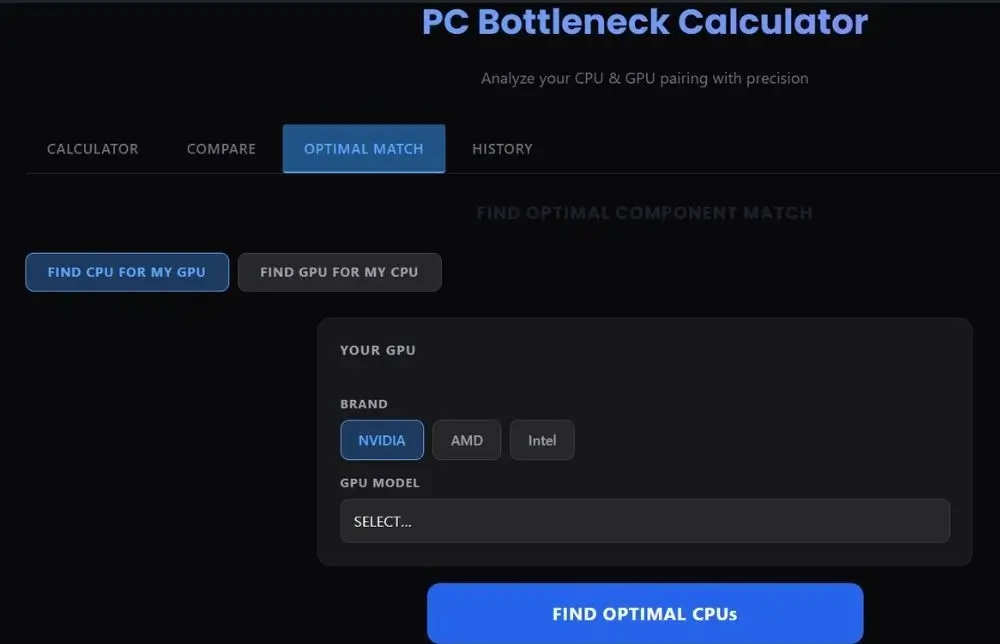
Enter your selected GPU after reading this guide, input it into the given field, and click on ‘Find Optimal CPU.’ Our calculator will show you a few options, from the best match to alternatives, so you can choose the right one for optimal performance
FAQs
Below, we’re answering some of the most common questions people ask on forums and elsewhere. We’ve tried to tackle the real issues users actually run into.
Is the RX 9060 XT better than the RTX 5060?
For most gamers, yes, especially the 16GB version. Benchmark data across more than 100 games shows the RX 9060 XT scoring 34 out of 100 compared to the RTX 5060’s 29 out of 100, making it about 17 percent faster on average. The bigger win is the 16GB of VRAM, which keeps games running smoothly at 1440p where the RTX 5060’s 8GB can start to struggle.
Is 8GB of VRAM enough in 2026?
For 1080p gaming at medium to high settings, 8GB is still mostly fine. But real world testing shows modern AAA titles like Black Myth Wukong, Indiana Jones and the Great Circle, and Cyberpunk 2077 regularly push past 8GB of VRAM at 1440p Ultra settings, leading to stutters and texture pop-in. If you want your card to last a few years or play at 1440p, 16GB is the safer choice.
Should I buy the RX 9060 XT 8GB or 16GB version?
If your budget allows it, go for the 16GB. The 8GB RX 9060 XT runs into trouble once games start asking for more memory than it has, and AMD itself only showcased the 16GB model in its official launch benchmarks, which tells you a lot about which version they consider the real product. For a card you might keep for several years, the extra memory is cheap insurance.
Can the RX 9060 XT or RTX 5060 handle ray tracing?
Both can run ray tracing, but Nvidia still has the edge here. The RTX 5060’s RT cores and DLSS 4 frame generation make ray traced games more playable, especially at 1080p. The RX 9060 XT’s ray tracing has improved a lot with RDNA 4, but it still trails Nvidia in heavy ray traced titles. For light to moderate ray tracing, both cards are usable, especially with upscaling turned on.
Is the RX 9060 XT good for 1440p gaming?
Yes, especially the 16GB version. In cumulative 1080p and 1440p benchmarks, the RX 9060 XT 16GB landed just 7 percent behind the RTX 5060 Ti 16GB, a noticeably more expensive card. It is one of the better budget options for 1440p gaming right now.
Which GPU is better for AMD vs Nvidia debate at this price point?
If you are weighing the broader Nvidia vs AMD question at the budget tier, AMD currently has the stronger argument with the RX 9060 XT 16GB. It offers more VRAM, competitive performance, and strong value. Nvidia still wins if DLSS 4 Multi Frame Generation and ray tracing performance are your top priorities, even on a budget card like the RTX 5060.
What do most people actually end up buying, AMD or Nvidia?
The community sentiment leans pretty heavily toward AMD at this price tier. A poll on TechPowerUp asking which GPU people would buy gathered over 16,000 votes, and the RX 9060 XT won by a landslide with more than 8,500 votes compared to roughly 3,500 for the Nvidia card.
Keep in mind this is a vote on value, not raw power. NVIDIA’s card is still more capable on paper, but a lot of buyers feel the price gap is not worth it for what they get in return.
Final Verdict: RX 9060 XT vs RTX 5060
In the RTX 5060 vs RX 9060 XT comparison, the RX 9060 XT, especially the 16GB version, is the smarter overall pick for most gamers in 2026. It delivers stronger 1440p performance, way more VRAM headroom, and genuinely competes with cards a tier above it like the RTX 5060 Ti. TechRadar’s review concluded that the RX 9060 XT 16GB strikes the best balance of price and performance in this class, and that lines up with what we are seeing across the board.
The RTX 5060 is not a bad card, it is just more limited. If you are strictly a 1080p gamer who wants DLSS 4 and Multi Frame Generation on a budget, it still gets the job done. But if there is any chance you will want to play at 1440p, or just want a card that ages well, the RX 9060 XT 16GB is the better long term investment.
| Category | Winner |
|---|---|
| 1080p Performance | RX 9060 XT (small margin) |
| 1440p Performance | RX 9060 XT (clear lead) |
| VRAM and Longevity | RX 9060 XT 16GB |
| Ray Tracing | RTX 5060 |
| Upscaling and Frame Gen | RTX 5060 (DLSS 4 MFG) |
| Power Efficiency | RTX 5060 |
| Best Value Overall | RX 9060 XT 16GB |
| Best for Pure 1080p Budget Builds | RTX 5060 |
You might also want to check our RX 9070 XT vs RTX 5080 comparison if you are considering a higher-tier build, our RX 9060 XT vs RTX 5060 Ti guide if you want to see how the next tier up compares, or our full Nvidia vs AMD guide if you are still weighing brands in general.
For more reading, check out TechPowerUp’s RX 9060 XT specs page and TechPowerUp’s RTX 5060 specs page for the full technical breakdowns straight from the source.
