

5060 vs 4070-Which NVIDIA GPU Should You Actually Buy
Quick Verdict: The Nvidia 5060 vs 4070 is not as close as Nvidia’s naming might suggest. The RTX 4070 is the stronger card by a clear margin. It’s around 28 to 30 percent faster on average, has 12GB of VRAM versus 8GB, and handles 1440p gaming noticeably better. If performance headroom matters to you, the RTX 4070 wins.
That said, the RTX 5060 isn’t a bad card. It costs less, draws only 145W, and brings DLSS 4 with Multi Frame Generation to the table. For 1080p gaming on a tighter budget or in a compact build, it makes a lot of sense.
At mypcbottleneck.com we spend a lot of time digging into GPU data to help people figure out exactly where their build is being held back. We’ve run both the RTX 5060 and the RTX 4070 through our bottleneck analysis tools and cross referenced the results against real benchmark data from hardware reviewers, so the numbers you’ll see here reflect actual gaming behavior, not just spec sheet math.
If you’re caught between the two and want to know exactly how each card pairs with your CPU before you buy, our bottleneck calculator can give you a build specific answer in seconds.
In this guide, we’re going to break down everything that actually matters for the 4070 vs 5060 decision: architecture, VRAM, ray tracing, real-world FPS across popular games, power draw, and which card fits which kind of build. We’ll also cover how the RTX 5060 holds up against the RTX 4070 Ti, 4070 Super, and 4070 Ti Super, plus how the RTX 5060 Ti 16GB compares to the base RTX 4070 if your budget has a little more room.
5060 vs 4070- Full Specs Comparison
Let’s start with the raw numbers side by side. This is where you’ll already start to see why these two cards aren’t really in the same weight class, even though people compare them all the time because of how they’re priced and positioned.
Right away, you can see the RTX 4070 has more raw horsepower across the board, more cores, more VRAM, and a wider memory bus. The RTX 5060 fights back with a newer architecture, faster GDDR7 memory chips, and a much lower power draw. So which one wins where it actually counts? Let’s dig in.
Architecture and Manufacturing
Both cards are built on a 4nm TSMC process, so they’re not far apart in terms of how modern the silicon is. The big difference is the architecture underneath. The Nvidia GeForce RTX 4070 uses Ada Lovelace, which was Nvidia’s big leap in efficiency back in 2022 and 2023. The RTX 5060 uses Blackwell, the newer design that brings improvements to the tensor cores, ray tracing hardware, and AI-driven features like DLSS 4.
Here’s the thing though. A newer architecture doesn’t automatically mean a faster card. Nvidia positioned the RTX 5060 as an entry level to mid range product, and that shows up in the much smaller core count compared to the RTX 4070. Think of it like comparing a brand new compact car to an older but bigger sedan. The new car might have better tech inside, but the sedan still has more room and more power under the hood.
5060 vs 4070- Gaming Performance
This is the part most people actually care about. When you look at the nvidia rtx 4070 vs rtx 5060 across a wide range of games at 1080p with everything cranked up, the RTX 4070 leads by around 28 to 30 percent on average. We’re not talking about a small margin here.
In one direct head to head test using identical system specs, the gap showed up clearly. Take a look at how the two cards stacked up in a demanding modern title:
Average FPS Comparison (1080p, Max Settings)
| Card | Avg FPS |
|---|---|
| RTX 5060 | 83 FPS |
| RTX 4070 | 104 FPS |
In that test, the RTX 4070 came out ahead by 21 FPS, with a higher minimum frame rate and lower frame times too. In aggregate benchmarks across hundreds of games, the 4070 vs rtx 5060 gap consistently lands around 28 to 30 percent, with some titles showing a difference as high as 33 percent depending on VRAM pressure and memory bandwidth usage.
The Nvidia GeForce RTX 5060 isn’t a slow card by any means; it’s just playing in a lower tier. Where it claws some performance back is in efficiency. It draws roughly 38 percent less power than the RTX 4070, which is a genuine advantage for compact builds or modest power supplies.
5060 vs 4070 Ti
If you’re comparing these two, brace yourself: the gap is not close. The RTX 4070 Ti is a significantly more powerful card, sitting well above the base RTX 4070 in Nvidia’s own lineup. It packs 7,680 CUDA cores versus the RTX 5060’s 3,840, has a 192-bit memory bus with 12GB GDDR6X VRAM, and a TDP of 285W.
In aggregate benchmarks across a large set of games, the RTX 4070 Ti leads the RTX 5060 by around 52 percent in overall gaming performance. That’s not a generational gap, that’s practically a different tier of card entirely. At 1080p and 1440p the RTX 4070 Ti handles everything the RTX 5060 can, and then some, with more headroom to spare for high refresh rate gaming and demanding new titles.
| Card | Aggregate Performance Score |
|---|---|
| RTX 5060 | 50.3 |
| RTX 4070 Ti | 76.4 (+52%) |
The only real arguments for the Nvidia RTX 5060 here are power draw (the 4070 Ti runs hot at 285W) and value for money; the RTX 5060 comes in at a much lower price point. If raw performance is your goal and the wattage doesn’t scare you, the RTX 4070 Ti isn’t even a close contest. But if you’re budget-conscious and gaming at 1080p, the RTX 5060 gives you solid results at a fraction of the operating cost.
Quick verdict: NVIDIA RTX 4070 Ti wins by a big margin in raw performance. RTX 5060 wins on efficiency and value.
5060 vs 4070 Super
The RTX 4070 Super sits between the base 4070 and the 4070 Ti in terms of performance, and it’s been a popular pick for 1440p gaming since its launch in early 2024. It comes with 7,168 CUDA cores, 12GB GDDR6X VRAM, a 192-bit memory bus, and a 220W TDP.
Up against the RTX 5060, the gap is substantial again. In synthetic benchmarks, the RTX 4070 Super leads by around 44 to 56 percent depending on the benchmark. In real game FPS comparisons at 1080p ultra settings, the 4070 Super puts up meaningfully higher frame rates across the board. In a demanding title like a modern open world game at 1080p ultra, the 4070 Super is pulling around 30 percent more frames than the RTX 5060 on average.
| Card | 1080p Avg FPS (example title) |
|---|---|
| RTX 5060 | 37 FPS |
| RTX 4070 Super | 48 FPS (+30%) |
At 1440p, the Nvidia RTX 4070 Super’s larger VRAM pool and wider memory bus give it an even bigger advantage. For 1440p gaming on high to ultra settings in newer titles, the RTX 5060 starts to feel constrained, while the RTX 4070 Super handles it comfortably.
The RTX 5060’s saving grace here is power efficiency, the 4070 Super draws 220W versus 145W, and the RTX 5060 carries significantly better value for money at its lower price point.
Quick verdict: RTX 4070 Super is the stronger card for 1440p. RTX 5060 is better if you’re watching your power bill and gaming at 1080p.
RTX 5060 vs RTX 4070 Ti Super
This one is the most lopsided comparison of the bunch. The RTX 4070 Ti Super is Nvidia’s high end Ada Lovelace card with 8,448 CUDA cores, 16GB GDDR6X VRAM, a 256-bit memory bus, and a 285W TDP. It was designed to compete at the top of the mid range and lower end of high end gaming.
Against the Nvidia RTX 5060, there’s simply no contest in raw performance. Aggregate benchmark data puts the RTX 4070 Ti Super about 53 percent ahead of the RTX 5060 across gaming workloads. That’s a bigger gap than even the 4070 Ti comparison above, and the 16GB VRAM on the Ti Super gives it headroom that the 8GB RTX 5060 can’t touch for 1440p and 4K gaming with high texture settings.
| Card | Aggregate Performance Score |
|---|---|
| RTX 5060 | ~50 |
| RTX 4070 Ti Super | ~76 (+53%) |
The RTX 4070 Ti Super also doubles the RTX 5060’s maximum VRAM capacity. If you’re doing anything beyond 1080p gaming, content creation, 3D rendering, high-resolution texture mods- the RTX 4070 Ti Super is in a completely different league.
That said, the RTX 5060 has dramatically lower power consumption (the 4070 Ti Super runs at 285W) and a much friendlier price tag. For a budget 1080p build, the RTX 5060 makes a lot more sense than spending top dollar on a Ti Super.
Quick verdict: RTX 4070 Ti Super crushes the RTX 5060 in performance at every resolution. Only consider the RTX 5060 if you’re strictly budget limited and sticking to 1080p.
RTX 4070 vs RTX 5060 Ti 16GB
Now here’s a comparison that flips the script a bit. If your budget stretches a little past the base RTX 5060, the RTX 5060 Ti 16GB becomes a very interesting option to stack up against the RTX 4070.
The RTX 5060 Ti 16GB launched in April 2025 at around $429. It uses Blackwell silicon with 4,608 CUDA cores, 16GB GDDR7 VRAM on a 128-bit memory bus, and a 180W TDP. The RTX 4070, by comparison, uses Ada Lovelace with 5,888 CUDA cores, 12GB GDDR6X on a 192-bit bus, and a 200W TDP.
In synthetic benchmarks, the RTX 4070 still leads by around 12 percent overall, with roughly 12 to 13 percent better scores in DirectX 12 and compute tests. In real game FPS at 1440p, the two cards land surprisingly close, reviewers from GamersNexus found the RTX 5060 Ti sitting right alongside the RTX 4070 in many titles at both 1080p and 1440p, with the gap often being within single digit percentage points depending on the game.
| Card | 3DMark DX12 Score | Avg Synthetic FPS |
|---|---|---|
| RTX 5060 Ti 16GB | 16,185 | 171.7 FPS |
| RTX 4070 | 18,116 (+12%) | 192 FPS (+12%) |
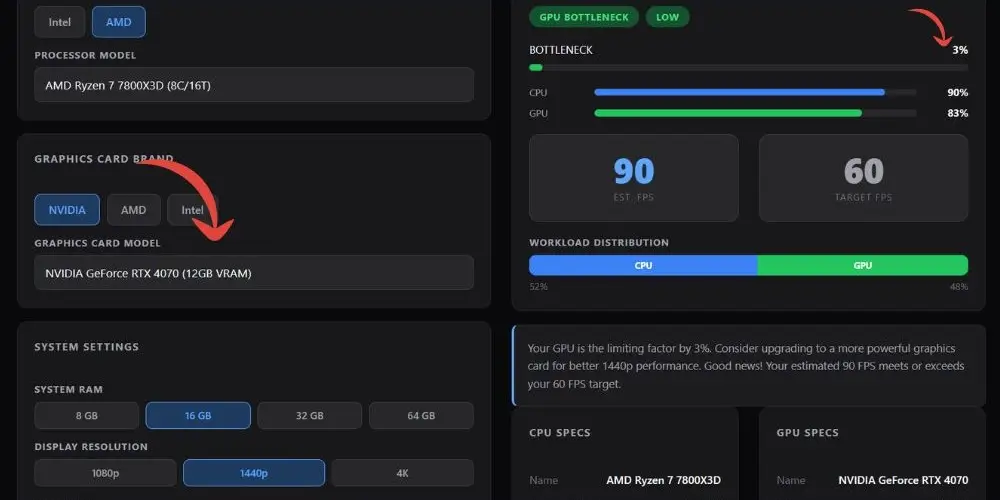
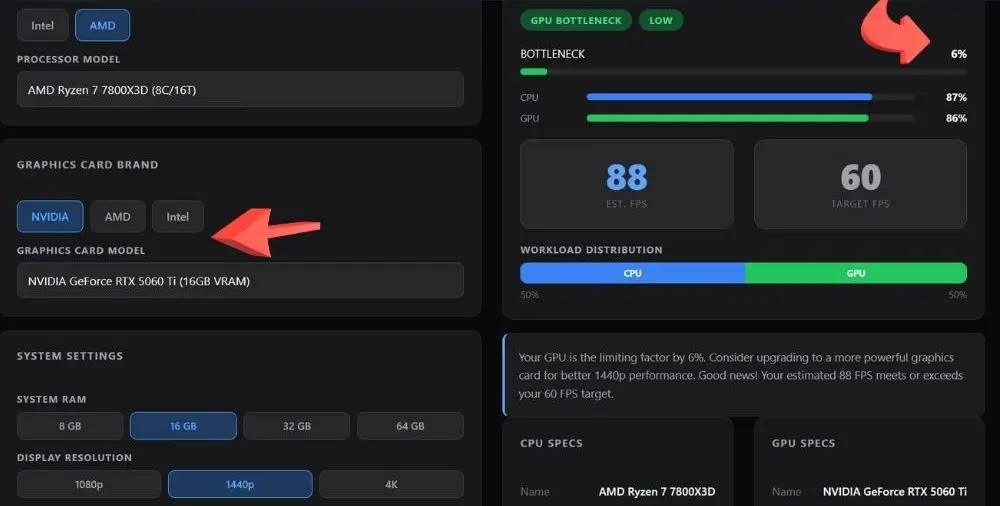
The RTX 4070 shows a 3% GPU bottleneck with the Ryzen 7 7800X3D at 1440p compared to 6% on the RTX 5060 Ti 16GB, confirming the RTX 4070 still has a small but real performance edge in a balanced high end build. The gap is close enough though that most gamers will not feel it in everyday gameplay.
Where the RTX 5060 Ti 16GB pulls ahead is VRAM. Having 16GB of GDDR7 versus the RTX 4070’s 12GB GDDR6X means the newer card has more room for texture heavy games, high resolution mods, and general longevity over the next few years of game releases. One source notes that the 16GB capacity removes the memory pressure that can cause stuttering in modern titles when pushing settings hard. The 5060 Ti also brings DLSS 4 with Multi Frame Generation, which the RTX 4070 doesn’t support.
The RTX 4070 still wins on raw rasterization speed and has a full 192-bit memory bus, which gives it higher peak bandwidth despite using older GDDR6X chips. It’s also the safer choice for older motherboards since it doesn’t require PCIe 5.0 for full speed operation.
| Feature | RTX 5060 Ti 16GB | RTX 4070 |
|---|---|---|
| VRAM | 16GB GDDR7 | 12GB GDDR6X |
| Memory Bus | 128-bit | 192-bit |
| CUDA Cores | 4,608 | 5,888 |
| TDP | 180W | 200W |
| DLSS | DLSS 4 + MFG | DLSS 3 + FG |
| Raw Performance | ~12% behind | Faster |
Quick verdict: In 5060 vs 4070, the RTX 4070 is still faster in raw rasterization, but the RTX 5060 Ti 16GB is a legitimate alternative for anyone who values VRAM headroom, newer AI features, and lower power draw at a lower price point.
RTX 5060 vs RTX 4070- Ray Tracing and Upscaling
The RTX 4070 has more RT cores overall, 46 compared to 30 on the RTX 5060, but those RT cores on the 5060 are a newer 4th-generation design. In practice, this means ray tracing performance ends up closer than the core count alone would suggest, though the RTX 4070 still generally holds an edge in heavy ray traced titles thanks to its larger VRAM pool and wider memory bus.
Where things get interesting is upscaling. The RTX 5060 supports DLSS 4 with Multi Frame Generation, which can generate multiple AI frames for every traditionally rendered frame. The RTX 4070 supports DLSS 3 with standard Frame Generation, which is still excellent but generates fewer frames per real frame. If you lean heavily on DLSS to hit higher frame rates, the newer tech on the RTX 5060 can help close some of the performance gap in supported games, though it won’t fully erase it.
VRAM: The 8GB vs 12GB Debate
This is honestly one of the biggest talking points in 5060 vs 4070 comparison and for good reason. The RTX 5060 ships with 8GB of GDDR7 VRAM, while the RTX 4070 comes with 12GB of GDDR6X. That extra 4GB on the 4070 isn’t just a number on a spec sheet, it actually matters for how well a card ages.
Modern games, especially ones with high resolution texture packs, ray tracing enabled, or heavy mod support, can chew through 8GB pretty quickly at 1440p and above. The RTX 4070’s 12GB buffer gives it more breathing room for the next few years of game releases. The RTX 5060’s 8GB is fine for 1080p gaming today, but it’s the spec most likely to become a bottleneck first if you plan on keeping the card for a long time.
If you’re curious about how VRAM amounts actually affect real-world performance in specific games, our bottleneck calculator can help you see where your build might be limited based on the GPU and CPU combo you’re running.
Power Consumption and Thermals
Power draw is one area where the RTX 5060 genuinely shines. With a TDP around 145W compared to the RTX 4070’s 200W, the 5060 runs cooler, needs less robust cooling, and is friendlier to smaller power supplies. If you’re building a compact ITX system or working with an older PSU that you don’t want to replace, that lower power draw can be a real deciding factor.
For most mid tower builds with a decent 600W or higher power supply, the RTX 4070’s higher TDP isn’t a dealbreaker, but it’s still worth factoring in if your case has limited airflow or you’re trying to keep noise levels down.
4070 vs 5060- Who Should Buy Each Card
Here’s how we’d break it down depending on what kind of build you’re working with.
Go with the RTX 4070 if: you’re gaming at 1440p and want consistently higher frame rates, you play games that are heavy on VRAM like open world titles with high res texture packs, or you want a card that’s more likely to handle upcoming games comfortably without dropping settings.
Go with the RTX 5060 if: you’re mainly gaming at 1080p, you’re building in a small form factor case or working with a limited power supply, or you want access to the newest DLSS 4 features and don’t mind staying at 8GB of VRAM for now.
Check out which is the best CPU for RTX 5060 with zero bottleneck.
Go with the RTX 5060 Ti 16GB if: you want the best of both worlds, newer Blackwell features, a generous 16GB VRAM buffer for long-term use, and performance that gets close to the RTX 4070 at a lower price point. It’s the sweet spot upgrade if the base RTX 5060 feels too limited, but the RTX 4070 is out of reach.
If you’re still deciding between these two and a few other options in this price range, check out our full breakdown of the best graphics cards for gaming in 2026 for more side by side comparisons.
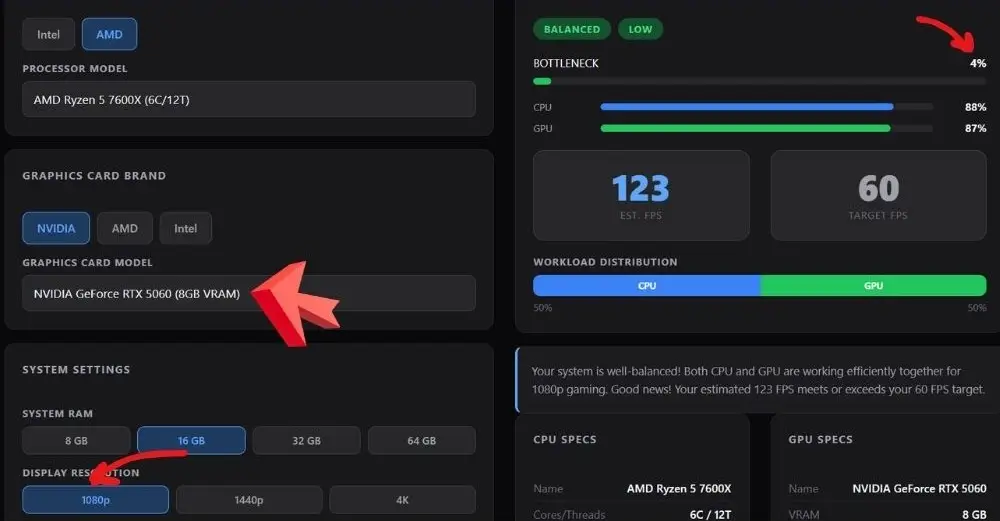
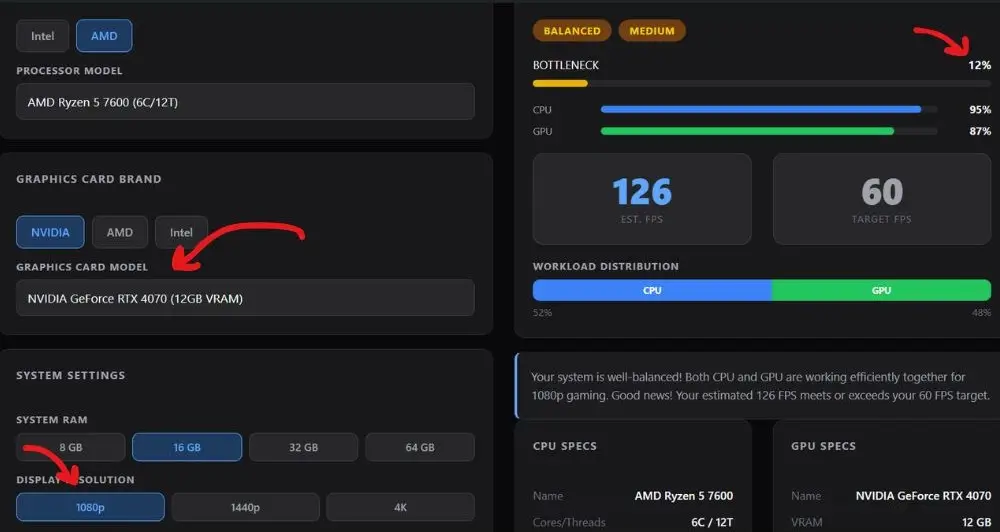
When paired with a Ryzen 5 7600 at 1080p, the RTX 5060 shows just a 4% GPU bottleneck making it a near-perfect match for a mid-range CPU build. The RTX 4070 with the same CPU jumps to 12%, meaning the Ryzen 5 7600 starts to hold it back, and you would need a stronger CPU like the Ryzen 7 7700X or i5 14600K to get the most out of it.
FAQ
Is the RTX 5060 basically the same as the RTX 4070?
No, despite both being positioned in a similar tier by Nvidia, the RTX 4070 is meaningfully faster across the board. A lot of people assume each new generation’s x060 card matches the previous generation’s x070 card, but that hasn’t been the case here. The RTX 4070 still leads in core count, VRAM, and average gaming FPS by around 28 to 30 percent on average.
Is 8GB of VRAM on the RTX 5060 going to be a problem?
For 1080p gaming right now, 8GB is generally fine for most titles. The concern people bring up most often in hardware communities is longevity. If you play newer AAA games with high texture settings or plan on using the card for several years, that 8GB could start to feel tight before the rest of the card does. The RTX 5060 Ti 16GB solves this problem at a modest premium.
How does the RTX 5060 hold up against the RTX 4070 Ti and 4070 Super?
Not great, if raw performance is what you’re after. The RTX 4070 Ti leads the RTX 5060 by around 52 percent in aggregate benchmarks, and the RTX 4070 Super leads by around 44 percent. These are not close comparisons — the RTX 5060 is a budget class card competing against upper mid range and performance class Ada Lovelace GPUs.
Should I upgrade from an older card like the RTX 3060 to the RTX 5060 or save up for the RTX 4070?
This comes up a lot in upgrade threads. If your budget allows it, the RTX 4070 gives you a bigger generational jump and more headroom for 1440p. The RTX 5060 is still a solid upgrade over older 60 class cards, especially if you’re focused on efficiency and 1080p performance, but it’s a smaller leap overall. Another option worth considering is the RTX 5060 Ti 16GB, which gets you closer to RTX 4070 territory at a lower cost.
Does the RTX 5060 run cooler and quieter than the RTX 4070?
Generally yes. With a lower TDP, most RTX 5060 cards run cooler and with less fan noise under load compared to RTX 4070 models, especially the higher TGP variants. This is one of the reasons it’s popular for compact builds.
In 5060 vs 4070, which card is better for ray tracing?
The RTX 4070 still has an edge in most ray traced games thanks to its larger VRAM pool and more total RT cores, but the RTX 5060’s newer 4th generation RT cores and DLSS 4 support help it perform better than its core count alone would suggest.
Is the RTX 5060 Ti 16GB worth it over the RTX 4070?
It depends on your priorities. The RTX 4070 is still around 12 percent faster in raw rasterization performance. But the RTX 5060 Ti 16GB offers more VRAM, DLSS 4 support, and comes in at a lower price. If VRAM headroom and newer software features matter more to you than squeezing out every last frame, the RTX 5060 Ti 16GB is genuinely competitive.
Final Verdict-5060 vs 4070
The 5060 vs 4070 comes down to what kind of gamer you are and what resolution you’re actually playing at. The RTX 4070 is the stronger card by a clear margin, around 28 to 30 percent faster on average, with 12GB of VRAM and better 1440p headroom that makes it the smarter buy if you want a GPU that stays comfortable for the next few years of game releases.
The RTX 5060 is not a pushover at 1080p and its 145W power draw makes it a genuinely good fit for compact builds and tighter budgets, but it cannot match the RTX 4070 in core count, memory bandwidth, or raw frame rate, and the 8GB VRAM ceiling is going to be the first thing that ages on it. If your budget stretches a little further, the RTX 5060 Ti 16GB closes a lot of that gap while bringing 16GB of GDDR7 and DLSS 4 support to the table.
Whatever you decide, make sure your CPU can actually keep up with the card you pick because a GPU upgrade that runs into a CPU bottleneck is money wasted.
