

5060 Ti vs 5070-Faster GPU or More VRAM? Which to Buy
In the 5060 Ti vs 5070 comparison, the RTX 5070 is the faster GPU overall and gives better performance, especially for 1440p gaming and even some light 4K. However, the RTX 5060 Ti 16GB is not far behind, and it comes with more VRAM, which can help in newer games.
If you mainly play at 1080p or 1440p and want extra future-proofing because of the higher VRAM, the RTX 5060 Ti is a smart choice. But if you want more raw power and higher FPS, the RTX 5070 is the better option in the 5060 Ti vs 5070 matchup.
Why This Comparison Confuses So Many People
The names make this one tricky. A lot of people assume the RTX 5060 Ti and RTX 5070 are basically the same tier because of how close the numbers sound. They’re not. The 5060 Ti vs 5070 matchup is actually a case where the card with the “smaller” number on paper, the 5060 Ti, has more memory, while the 5070 has more raw compute power. That mismatch is exactly why so many people end up confused about which one is actually worth buying.
This naming overlap isn’t new either. Nvidia has done it before with past generations, and every time, it leads to the same searches and the same forum threads asking which card actually wins.
Table of Contents
5060 Ti vs 5070 Specs
The RTX 5070 has roughly a third more cores than the RTX 5060 Ti, which is why it consistently performs faster in actual games. But the RTX 5060 Ti holds an edge in VRAM capacity, which matters more in some games and at higher resolutions than people expect.
How These Specs Actually Translate to Gaming Performance
Specs on paper are one thing, but what actually happens in games is what matters. The RTX 5070’s extra cores and wider memory bus give it a real, consistent lead in raw frame rate across most titles, especially anything that leans heavily on compute power rather than memory capacity. Competitive shooters, older titles, and most esports games will run noticeably better on the 5070.
Where things get more interesting is in newer, more demanding games, especially ones with high-resolution texture packs, ray tracing, or mods that push VRAM usage higher. In those cases, the RTX 5060 Ti’s extra memory can help it avoid stutters or texture pop-in that the RTX 5070 might run into once its 12GB starts filling up. It’s not that the 5060 Ti suddenly outperforms the 5070 in these scenarios. It’s that the 5070’s raw power advantage can get partially erased if it starts running low on VRAM mid-game.
Real Bottleneck Data for RTX 5060 Ti vs RTX 5070
Specs only tell half the story. To see how the 5070 vs 5060 ti 16gb matchup actually behaves in a real system, we ran both through our bottleneck calculator paired with two different CPUs: the AMD Ryzen 7 9800X3D, a high-end gaming chip, and the AMD Ryzen 5 9600X, a more budget-friendly option.
Both tests were run at 1080p with 16GB of system RAM and a 60 FPS target.
Estimated FPS by CPU + GPU pairing
1080p, 60 FPS target, 16GB system RAM. Source: our bottleneck calculator.
Ryzen 7 9800X3D
8% bottleneck · CPU 95% · GPU 89%
11% bottleneck · CPU 84% · GPU 85%
Ryzen 5 9600X
5% bottleneck · CPU 84% · GPU 83%
3% bottleneck · CPU 86% · GPU 87%
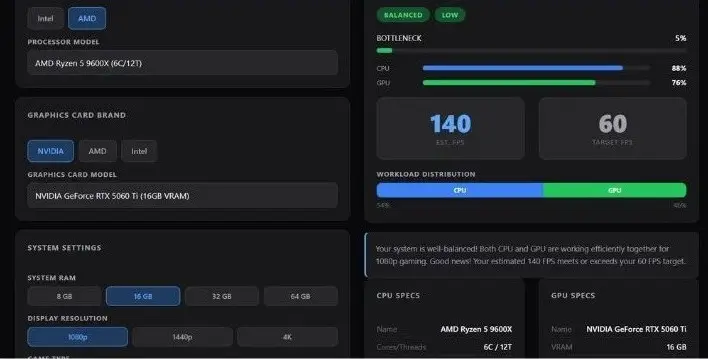
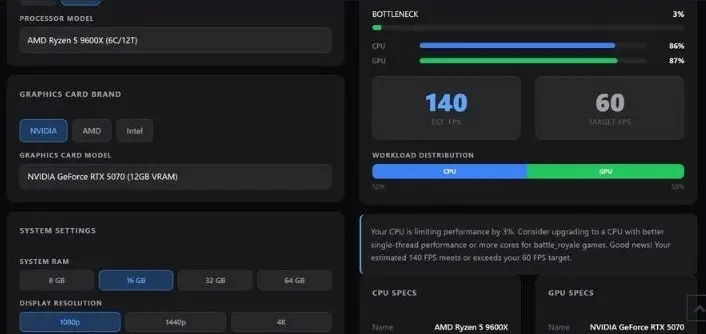
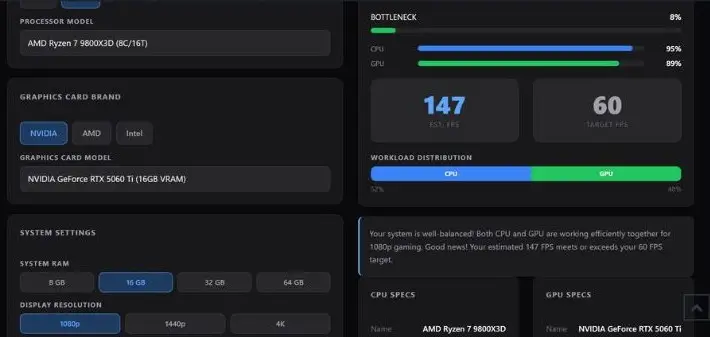
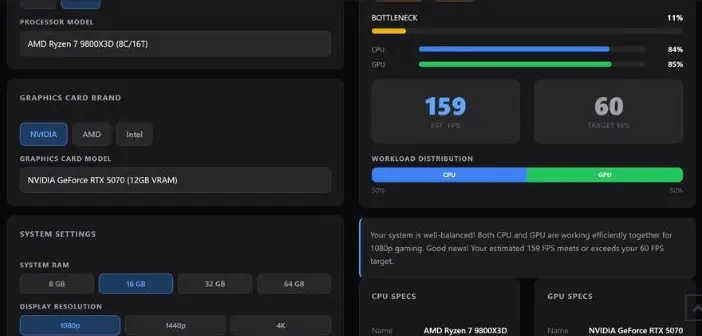
A few things stand out here. With the Ryzen 7 9800X3D, the RTX 5070 pulls ahead with 159 FPS compared to 147 FPS on the RTX 5060 Ti, a real gap of about 8%. That tracks with what the specs would suggest, since the 5070 has more raw compute power to put to use once it has a CPU fast enough to keep feeding it.
The more interesting result shows up with the Ryzen 5 9600X. Both GPUs land at exactly 140 FPS. On this CPU, the RTX 5070’s extra horsepower simply does not show up in the final frame rate, because the CPU itself becomes the limiting factor before the GPU difference can matter. In other words, the 5070’s advantage over the 5060 Ti only fully shows up when it is paired with a strong enough CPU to support it.
One quick note on the bottleneck percentage: it does not move in a perfectly straight line with FPS. The 9800X3D plus RTX 5070 combo shows the highest FPS of the four tests but also the highest bottleneck reading. That is because the calculator measures relative headroom against your target FPS, not raw speed, so a faster combo can still show a higher percentage if it has less spare headroom left over. Always look at the estimated FPS number alongside the bottleneck percentage rather than the percentage alone.
Which CPU Should You Pair With Each Card
Based on the data above and our dedicated CPU guides, here is the straightforward answer.
If you’re buying the RTX 5070, pair it with the strongest CPU you can reasonably afford. Our best CPU for RTX 5070 and RTX 5070 Ti guide names the Ryzen 7 9800X3D as the top overall pick, and the data above backs that up. The 5070 only delivered its full performance advantage when paired with the 9800X3D. On the more budget-friendly Ryzen 5 9600X, that advantage disappeared completely, meaning you’d be paying more for the GPU without actually getting more frames.
If you’re buying the RTX 5060 Ti, you have more flexibility. Our best CPU for RTX 5060 Ti guide also points to the Ryzen 7 9800X3D as the best overall pairing, but the Ryzen 5 9600X is a strong value pick here too. Since the 5060 Ti is the less demanding card of the two, it does not need quite as much CPU horsepower to perform well, and the gap between budget and high-end CPU pairings is smaller than it is with the 5070.
The simplest rule of thumb: if your budget is split between CPU and GPU, do not buy the RTX 5070 and pair it with a budget CPU. You’ll end up with the same frame rate as someone who bought the cheaper RTX 5060 Ti instead, just for more money. If your CPU budget is tight, the RTX 5060 Ti is the smarter buy, since it does not leave performance on the table the way the 5070 does when it’s held back by a weaker processor.
VRAM vs Raw Power: Which One Actually Matters More
This is the part people argue about most online, especially in PC building forums and subreddits like r/buildapc and r/pcmasterrace. In the 5060 ti 16gb vs 5070 12gb matchup, the RTX 5070 wins in raw performance in almost every game tested. But the RTX 5060 Ti’s extra memory gives it more breathing room in newer, more demanding titles, especially at 1440p with ray tracing or texture-heavy mods turned on.
If you play mostly competitive or older titles, the extra VRAM on the 5060 Ti probably won’t matter much. If you play newer AAA games and want your card to age well, the extra memory buys you some peace of mind, even if the NVIDIA GeForce RTX 5070 is faster right now.
There’s also a longer-term angle here. Game developers keep pushing VRAM requirements higher with every generation, especially as 4K textures and ray tracing become more standard rather than optional. A card with more memory headroom tends to hold up better a few years down the line, even if it’s slightly behind on raw power today.
Future-Proofing: Which Card Ages Better
This is one of the most common questions people ask once they get past the initial spec comparison. Nobody wants to spend money on a GPU that feels outdated in two years.
The honest answer is that it depends on what kind of “outdated” you’re worried about. If you’re worried about raw horsepower not keeping up with newer, more demanding games, the RTX 5070 has the edge since it simply has more compute power to begin with. If you’re worried about running out of VRAM and seeing stutters or forced settings drops in future titles, the RTX 5060 Ti’s extra memory gives it an advantage there.
Most people who keep their GPU for four or five years tend to run into VRAM limitations before they run into raw power limitations, especially at 1080p and 1440p where these cards are mainly built to perform. That’s part of why the RTX 5060 Ti has built up a loyal following among budget-conscious builders who want their card to last.
Common Mistakes People Make When Choosing Between 5060 Ti vs 5070
Assuming the Ti suffix means a higher tier. A lot of buyers assume “Ti” always means better, since that’s been true in some past Nvidia generations. In this case, the 5060 Ti and 5070 sit close enough that it’s not a clean step up or down, it’s a tradeoff.
Ignoring their CPU when picking a GPU. Plenty of people pick whichever card scores higher on paper without checking if their current CPU can actually keep up with it. Pairing either of these cards with a weaker or older CPU means you won’t see the GPU’s full potential, especially at 1080p.
Overvaluing VRAM without checking actual usage. Some buyers chase VRAM capacity without confirming whether the games they actually play come close to using it. If you mostly play competitive titles or older games, 12GB is plenty, and you might be better off with the extra raw power instead.
Underestimating power requirements. The NVIDIA GeForce RTX 5070 draws noticeably more power and uses a different connector than the RTX 5060 Ti. If you’re upgrading inside an older system, it’s worth double-checking your power supply has the right connector and enough headroom before buying.
5060 Ti vs 5070- Who Should Buy the RTX 5060 Ti
We may earn a commission from purchases made through these links, at no extra cost to you.
- You play mainly at 1080p or 1440p
- You want extra VRAM headroom for future games
- You’re building a more budget-friendly system
- You don’t need flagship-level raw performance
- You want lower power draw and simpler power requirements
Still not sure you even need the Ti? Our RTX 5060 vs RTX 5060 Ti guide breaks down whether the regular 5060 already covers what you need.
Who Should Buy the RTX 5070
- You want the fastest GPU in this matchup
- You play at 1440p and want some 4K headroom
- You do content creation, rendering, or AI workloads alongside gaming
- You don’t mind the lower VRAM ceiling in exchange for more power
- You have a power supply that can comfortably handle the higher draw
If the 5070 has you eyeing something with even more headroom, our RTX 5070 vs RTX 5070 Ti guide lays out exactly how much more performance that next step up gets you.
Frequently Asked Questions
1. Is the RTX 5060 Ti bottlenecked by weaker CPUs?
Yes, like any GPU, the NVIDIA GeForce RTX 5060 Ti can be held back by an older or weaker CPU, especially at 1080p where the CPU does more of the heavy lifting. Pairing it with a modern mid-range CPU avoids most of this issue.
2. CUDA cores or VRAM, which one matters more for gaming?
It depends on the game. If the textures and settings you are running fit within the available VRAM, core count is what drives raw frame rate. But once VRAM runs out, that becomes the bottleneck no matter how many cores the card has. Neither one universally wins out over the other.
3. Is the RTX 5070 worth the extra cost over the RTX 5060 Ti?
For most gamers, the RTX 5070 offers a noticeable performance jump that justifies the price gap, especially for 1440p gaming. If you are on a tighter budget or VRAM matters more for your use case, the RTX 5060 Ti is still a strong card.
4. Can the RTX 5060 Ti handle 1440p gaming?
Yes, the RTX 5060 Ti 16GB handles 1440p gaming well in most titles, though you may need to lean on DLSS in more demanding games to keep frame rates high.
5. Is ray tracing better on the RTX 5060 Ti or the RTX 5070?
The RTX 5070 generally pulls ahead in ray tracing thanks to its higher core count and more RT cores. That said, neither card handles ray tracing flawlessly in the newest, most demanding titles, so DLSS 4 ends up carrying a lot of the load on both.
6. Does the RTX 5060 Ti need a different power supply than the RTX 5070?
Not necessarily a different one, but the RTX 5070 draws more power and uses a 16-pin connector, so it is worth confirming your power supply can handle it before upgrading.
Final Words
So that’s the 5060 Ti vs 5070 matchup boiled down to what actually matters. The RTX 5070 is the faster card almost everywhere, and once you pair it with a strong enough CPU like the 9800X3D, that extra power really shows up in your FPS counter. The RTX 5060 Ti isn’t far behind though, and it brings more VRAM to the table, which matters more than people expect once you start playing newer, more demanding games at 1440p.
If you’re chasing raw speed and your CPU can keep up, go with the RTX 5070. If you want a card that won’t run into memory limits a couple years down the line, or you’re working with a tighter CPU budget, the RTX 5060 Ti 16GB is the smarter buy. Either way, don’t forget the GPU is only one piece of the puzzle. Run your full setup through our bottleneck calculator before you buy, so your CPU, RAM, and PSU are all pulling their weight alongside whichever card you pick.
