

RTX 5070 vs RX 9070 XT: Which GPU Should You Buy?
Tyler had finally saved enough for a real 1440p gaming upgrade. He narrowed it down to two cards: Nvidia’s RTX 5070 and AMD’s RX 9070 XT. His friends on Discord were split right down the middle. One said Nvidia’s DLSS made the choice easy. Another said the AMD card was simply faster and had more memory.
Tyler did not want opinions. He wanted to know which card would give him the best experience for his money, not just today but three years from now.
If you are stuck on the same choice, this guide compares the RTX 5070 vs RX 9070 XT using official specs from Nvidia and AMD and large independent tests covering more than 50 games. You will see where each card wins, where the extra memory matters, and which one makes more sense for your setup.
How we checked: specs come from Nvidia’s and AMD’s official product pages. Performance figures come from TechSpot’s independent multi-game testing, and upscaling quality comes from TechSpot’s DLSS vs FSR analysis. We did not test these cards hands-on.
Quick answer: the RX 9070 XT is the faster card. In TechSpot’s updated 52-game test, it was about 24% faster at 1440p and 25% faster at 4K than the RTX 5070, with stronger 1% lows. It also has 16GB of memory versus 12GB. The RTX 5070 wins on upscaling quality (DLSS), uses less power, and leads in a few path-traced games. For most gamers, the RX 9070 XT is the better buy, unless you care most about DLSS or full path tracing.
RTX 5070 vs RX 9070 XT: Specs Compared
| Spec | RTX 5070 | RX 9070 XT |
|---|---|---|
| Architecture | Nvidia Blackwell | AMD RDNA 4 |
| Shader cores | 6,144 CUDA cores | 4,096 stream processors (64 compute units) |
| Boost clock | 2.51 GHz | Up to 2.97 GHz |
| Video memory | 12GB GDDR7 | 16GB GDDR6 |
| Memory bus | 192-bit | 256-bit |
| Extra cache | n/a | 64MB Infinity Cache |
| Power | 250W total graphics power | 304W total board power |
| Recommended power supply | 650W | 750W |
| PCIe | PCIe 5.0 | PCIe 5.0 x16 |
| Upscaling | DLSS 4, including Multi Frame Generation | FSR 4 |
Table of Contents
Table of Contents
Note: core counts cannot be compared directly between Nvidia and AMD, because the two designs work differently. Real game results, covered next, are what matter.
Gaming Performance: The RX 9070 XT Wins Clearly
This is the biggest difference between the two cards, and independent testing is consistent about it.
| Test | RX 9070 XT lead over RTX 5070 |
|---|---|
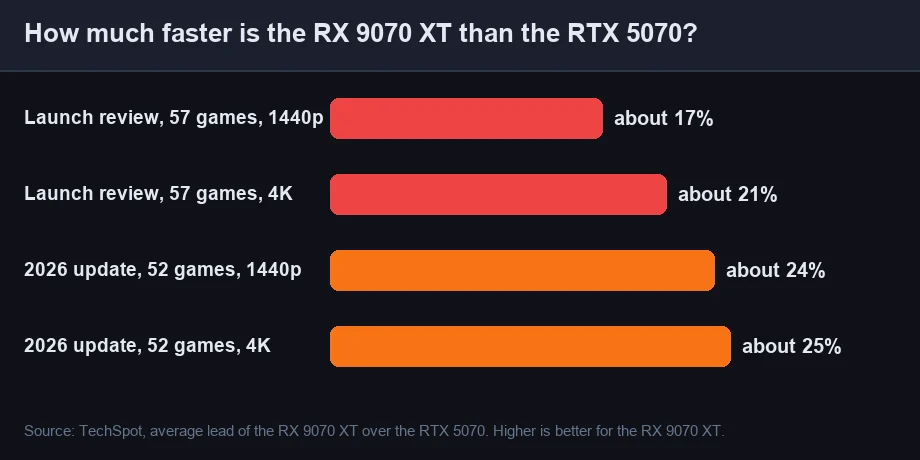
| TechSpot launch review, 57 games, 1440p | About 17% |
| TechSpot launch review, 57 games, 4K | About 21% |
| TechSpot 2026 update, 52 games, 1440p | About 24% |
| TechSpot 2026 update, 52 games, 4K | About 25% |
The gap was larger in the 2026 update, which used newer drivers and a different game list, so the RX 9070 XT’s lead has held up well over time. TechSpot also found the RX 9070 XT had substantially stronger 1% lows, the measurement you feel as smoothness and fewer stutters.
Biggest wins for each card
- RX 9070 XT: large leads in games such as Final Fantasy XVI, Ark: Survival Ascended, Starfield and 007 First Light, where TechSpot measured leads of roughly 28% to 57% depending on the game and resolution.
- RTX 5070: wins in Counter-Strike 2 at 4K, and in heavily path-traced games such as Doom: The Dark Ages and Indiana Jones and the Great Circle with full ray tracing. Overwatch was close to a tie.
What this means for you: if you mainly play standard games at 1440p, the RX 9070 XT gives you noticeably more frames in most of them.
Ray Tracing: Closer Than You Might Think
For years, Nvidia was the easy pick for ray tracing. With RDNA 4, AMD closed much of that gap, and in TechSpot’s 2026 testing the RX 9070 XT generally led with ray tracing turned on.
- Where the RX 9070 XT led: Dying Light: The Beast (about 22% to 29% ahead) and The Witcher 3 with RT Ultra (about 16% at 1440p and 28% at 4K). In Cyberpunk 2077 with RT Ultra at 4K, the RTX 5070 dropped to around 9 FPS, a sign it was running short of video memory.
- Where the RTX 5070 led: games that use full ray tracing or path tracing. TechSpot measured the RTX 5070 about 10% ahead at 1440p and 19% ahead at 4K in Indiana Jones and the Great Circle with full ray tracing, and about 32% ahead in Doom: The Dark Ages with path tracing at 1440p.
The takeaway: for normal ray tracing settings, the RX 9070 XT is the stronger card. If you specifically want the heaviest path-traced modes, Nvidia still has the edge.
VRAM: 12GB vs 16GB Is the Hidden Deciding Factor
The RTX 5070 has 12GB of video memory, while the RX 9070 XT has 16GB. That difference matters more each year.
Video memory (VRAM) holds the textures and data a game needs right now. When a game needs more than the card has, it has to borrow slower system memory, which causes stutter and big frame drops.
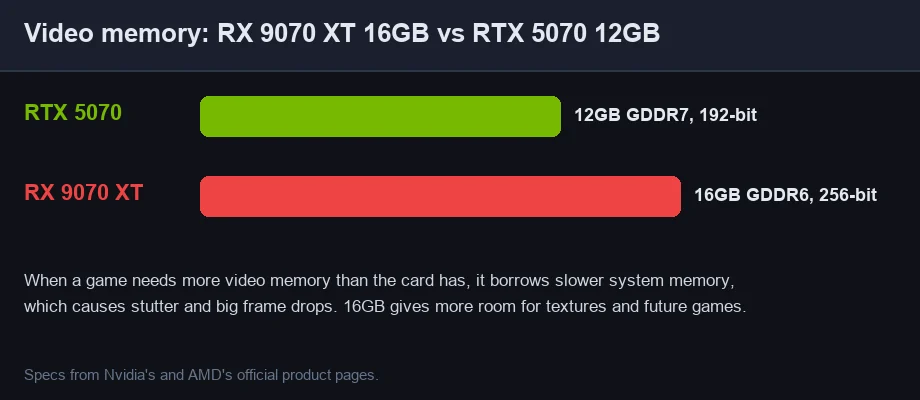
TechSpot described the RTX 5070’s 12GB as “somewhat questionable” and noted it ran into memory limits in games such as Mafia: The Old Country at Epic settings and Star Wars Outlaws at 4K. The RX 9070 XT’s 16GB gives it more room for high-resolution textures today and for heavier games in the future.
What this means for you:
- 1440p today: 12GB is still workable in most games, but a few already push it.
- 4K, or keeping your card for 3 or more years: the 16GB RX 9070 XT is the safer choice.
Want the full explanation? See our guide to what VRAM is and how much you need.
Upscaling and Features: Where the RTX 5070 Fights Back
Upscaling renders a game at a lower resolution, then uses AI to rebuild a sharp image, giving you more frames. Both cards have a strong AI upscaler, but they are not equal.
| Feature | RTX 5070 | RX 9070 XT |
|---|---|---|
| AI upscaler | DLSS 4 and newer | FSR 4 |
| Frame generation | Yes, including Multi Frame Generation | Yes |
| Game support | Very wide | Growing, but smaller |
- Image quality: TechSpot’s comparison of DLSS 4.5 and FSR 4 found DLSS generally delivers the better image, often by one to two quality tiers, with sharper detail and less ghosting. FSR 4 is still good, and handles some scenes such as grass and hair well.
- Multi Frame Generation: Nvidia’s 50 series can generate several extra frames for each real one. It can make high refresh rate monitors feel smoother, but it adds some input delay and works best when the base frame rate is already decent.
- Game support: DLSS appears in more games, so RTX owners get AI upscaling in more of their library.
The takeaway: if you rely on upscaling in almost every game, the RTX 5070 narrows the gap. But upscaling does not create more video memory, and it does not erase a 24% raw performance difference.
Power, PSU and Value
Power and power supply
| RTX 5070 | RX 9070 XT | |
|---|---|---|
| Rated power | 250W | 304W |
| Recommended PSU | 650W | 750W |
| Power connectors | One 12V-2×6 (varies by model) | 2x 8-pin (reference design) |
The RTX 5070 is the more efficient card and runs on a smaller power supply. If you already own a good 650W unit, the RTX 5070 may save you a PSU upgrade. Not sure what you have? Our PSU calculator sizes it for your exact build.
Value
Prices change daily, especially during the memory shortage, so check current listings. But in TechSpot’s 2026 pricing check, the RX 9070 XT was selling for less than the RTX 5070 in the US, and the RTX 5070 worked out to about 37% higher cost per frame at 1440p. Faster, more memory and cheaper makes the RX 9070 XT the stronger value pick whenever that price pattern holds.
Check before you buy: if you find an RTX 5070 noticeably cheaper than an RX 9070 XT, the value picture changes. Compare both prices on the day you buy.
Pair It With the Right CPU (Avoid a Bottleneck)
Both of these are strong 1440p cards, so an older or weak CPU can hold them back, especially in CPU-heavy games and at high refresh rates. If that happens, you pay for frames your graphics card cannot deliver.
Good pairings for either card:
- Best gaming results: Ryzen 7 7800X3D or Ryzen 7 9800X3D
- Strong value on AM5: Ryzen 5 7600 or 9600X
- Already on AM4: Ryzen 7 5700X3D is the best drop-in upgrade
- Intel: Core i5-13600K or 14600K, or Core i5-14400F for a budget build
For detailed picks, see our best CPU for RTX 5070 and RTX 5070 Ti guide and our best CPU for 9070 XT guide. To check your current CPU with either card, run it through our free PC bottleneck calculator.
RTX 5070 or RX 9070 XT: Which Should You Buy?
| Your situation | Better choice |
|---|---|
| You want the most frames for your money at 1440p | RX 9070 XT |
| You play at 4K or plan to keep the card 3+ years | RX 9070 XT (16GB of memory) |
| You use high-resolution texture packs or mods | RX 9070 XT |
| You rely on upscaling in almost every game | RTX 5070 (better DLSS image quality and wider support) |
| You want the best full path tracing | RTX 5070 |
| You have a 650W PSU and do not want to replace it | RTX 5070 |
| You also use the card for AI tools or Nvidia-only apps | RTX 5070 |
AMD Radeon RX 9070 XT: best for most gamers
Faster in most games, stronger 1% lows, 16GB of memory, and in recent US pricing, the cheaper of the two. Check that your power supply is at least 750W.
Nvidia GeForce RTX 5070: best for DLSS and efficiency
The better pick if you value DLSS quality, Multi Frame Generation, path tracing or lower power draw, especially if it is priced below the RX 9070 XT where you shop.
Still weighing the non-XT card? See our RX 9070 vs RTX 5070 comparison and our 9070 vs 9070 XT guide.
Can you stretch your budget? See how the RX 9070 XT compares with Nvidia’s faster card in our RX 9070 XT vs RTX 5070 Ti comparison.
RTX 5070 vs RX 9070 XT: FAQs
Is the RX 9070 XT faster than the RTX 5070?
Yes. In TechSpot’s updated 52-game test, the RX 9070 XT was about 24% faster at 1440p and 25% faster at 4K, with stronger 1% lows.
Is the RTX 5070 better for ray tracing than the RX 9070 XT?
Not in most games. The RX 9070 XT generally led with standard ray tracing in TechSpot’s testing. The RTX 5070 still wins in games with full ray tracing or path tracing, such as Indiana Jones and the Great Circle and Doom: The Dark Ages.
Is 12GB of VRAM enough on the RTX 5070?
For most games at 1440p, yes for now. But TechSpot found it running short in some demanding games at high settings and 4K, so the 16GB RX 9070 XT is safer for the future.
Is DLSS better than FSR 4?
Usually, yes. TechSpot found DLSS generally produces a sharper, more stable image than FSR 4, and DLSS is available in more games. FSR 4 is still a big step up from older FSR versions.
What power supply do I need for the RX 9070 XT and RTX 5070?
AMD recommends at least 750W for the RX 9070 XT. Nvidia lists 650W for the RTX 5070.
Which is better for 1440p gaming?
The RX 9070 XT for most people, because it delivers more frames and has more memory. The RTX 5070 makes sense if you rely heavily on DLSS or want the best path tracing.
Final Verdict: RTX 5070 vs RX 9070 XT
Tyler went with the RX 9070 XT. He plays at 1440p, wanted his card to last, and the extra speed and 16GB of memory mattered more to him than DLSS. His friend who plays mostly path-traced single-player games went the other way and picked the RTX 5070, and both are happy.
That is the honest answer to the RTX 5070 vs RX 9070 XT question. The RX 9070 XT is the better card for most gamers: it is roughly a quarter faster in large independent testing, has more memory, and has recently been the cheaper option. The RTX 5070 is the right pick if you value DLSS image quality, Multi Frame Generation, full path tracing or lower power draw.
Before you buy, check your CPU with our free PC bottleneck calculator, confirm your power supply with our PSU calculator, and check our today’s deals page for current GPU deals.
Sources
- AMD: Radeon RX 9070 XT specifications
- Nvidia: GeForce RTX 5070 family specifications
- TechSpot: GeForce RTX 5070 vs Radeon RX 9070 XT, 2026 update (52 games)
- TechSpot: AMD Radeon RX 9070 XT vs Nvidia GeForce RTX 5070 (57 games)
- TechSpot: Nvidia DLSS 4.5 vs AMD FSR 4


